
How to Order Certified IGI Diamonds Online in India
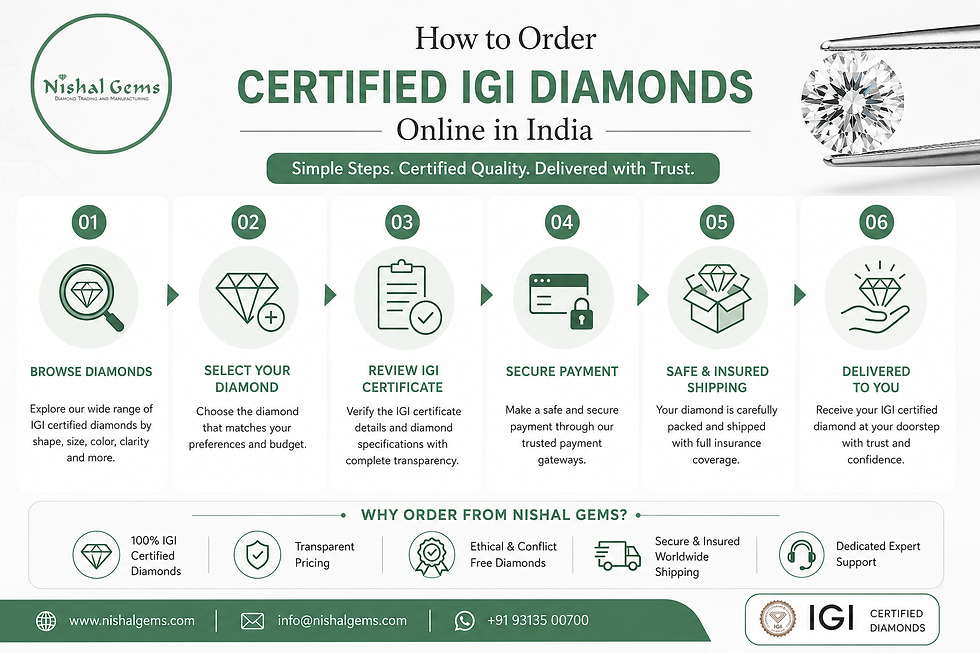
We get some version of this question almost every week: "Where can I actually order certified IGI diamonds online in India, and how do I know I'm not getting scammed?"
It's a fair question. And honestly, the internet doesn't make it easy to answer. Type "buy diamonds online India" into Google and you'll get a wall of marketplaces, all claiming to be certified, all claiming to be the cheapest, all looking more or less identical. Here's the thing — most of them aren't lying exactly. But "certified" gets used loosely, and that's where buyers get into trouble.
We've been on the manufacturing side of this industry since 1992, first with natural diamonds and now with lab-grown CVD and HPHT stones. We've watched hundreds of retailers, and a growing number of individual buyers, place their first online diamond order. This guide is the version of that conversation we'd have with you directly, minus the sales pitch.
What "IGI Certified" Actually Means
Let's start here, because this is where most of the confusion begins.
IGI — the International Gemological Institute — is one of the largest independent diamond grading labs in the world, alongside GIA and GCAL. When a diamond is "IGI certified," it means an independent lab has examined the stone and issued a report grading its 4Cs: cut, color, clarity, and carat weight.
That report is not a marketing label. It's a specific document with a unique report number. And this is the part buyers skip: every legitimate IGI report can be looked up on IGI's own website using that report number. If a seller can't give you a report number, or the number doesn't match anything in IGI's database, walk away. It's that simple.
We've seen listings online that say "IGI certified quality" without actually attaching a report. That phrase means nothing. A diamond is either accompanied by a specific, verifiable report, or it isn't certified — no matter what the listing says.
Where People Actually Order Certified Diamonds Online in India
There are three broad channels, and each comes with a different risk profile.
1. Consumer jewelry marketplaces
Sites built for retail buyers — engagement rings, finished jewelry, small quantities. Convenient, usually have return policies, but prices include significant retail markup.
2. Factory-direct manufacturers and exporters
This is where wholesale buyers, retailers, and private label brands typically order from. Prices are lower because you're closer to the source, but the burden of verification shifts more to you — you need to confirm the manufacturer is legitimate, GJEPC-registered, and has a real physical operation, not just a website.
3. Diamond trading platforms and B2B portals
Aggregators that list stones from multiple sellers. Useful for comparison shopping, but quality control varies by which trader is behind each listing.
None of these is inherently "the right one." It depends on whether you're buying one stone for personal use or sourcing inventory for a business. What matters more than the channel is the verification process you run before paying.
The Verification Checklist We'd Actually Use
If someone on our own team were ordering a diamond from an unfamiliar seller, here's what we'd check, in order.
Ask for the report number, not just a photo of a certificate. Photos can be edited. A report number can be independently verified on IGI's site in under a minute.
Request video of the actual stone, not a stock image. Any legitimate seller — manufacturer or marketplace — should be able to send a short video of the exact stone you're buying, not a "similar" one.
Confirm the business is registered. Look for GJEPC (Gem & Jewellery Export Promotion Council) membership or equivalent industry credentials. This won't guarantee quality on its own, but a seller unwilling to share basic business registration details is a red flag.
Check the payment structure. Be cautious of sellers who insist on full payment upfront via untraceable methods before you've received any documentation. Reputable sellers, especially on B2B orders, are usually open to structured payment terms once trust is established.
Understand the return and dispute policy before you order — not after. This sounds obvious. We're still surprised how often buyers skip it.
Retail Buyer vs. Wholesale Buyer: Different Questions
If you're buying a single stone for an engagement ring or personal jewelry, your main concerns are certification, price transparency, and return policy. A consumer marketplace with clear IGI documentation is usually the simpler path.
If you're a retailer, importer, or private label brand sourcing diamonds in volume, the calculation changes. You're less worried about a single stone's story and more focused on consistent quality across a parcel, reliable turnaround, and a sourcing relationship you can repeat. That's a conversation we have constantly with retailers who are used to buying finished jewelry and are sourcing loose certified stones for the first time — the process feels unfamiliar, but the fundamentals (verify the report, confirm the seller, agree on terms in writing) don't change.
A Quick Note on Lab-Grown vs. Natural
Since this question comes up in almost every conversation about online ordering: IGI certifies both natural and lab-grown diamonds, and the grading standards for the 4Cs are the same either way. The report will clearly state whether the stone is natural or laboratory-grown — that's a required disclosure, not an optional detail. If a listing is vague about which one you're getting, that's another place to ask directly before ordering.
Red Flags We Tell Every Buyer to Watch For
No report number, or a report number that returns no match on IGI's database
Pressure to pay immediately, "before the price changes"
Reluctance to provide video or high-resolution images of the specific stone
No physical business address or verifiable industry registration
Pricing that's dramatically below market with no clear explanation
None of these alone is automatically a scam. But two or more together should slow you down.
Where This Leaves You
Ordering certified IGI diamonds online in India isn't complicated once you know what to check. The report number is your single most reliable tool — verify it independently, every time, regardless of how polished the seller's website looks. Beyond that, match the channel to your need: marketplaces for convenience and smaller orders, factory-direct or B2B sourcing for volume and better pricing, provided you do the verification work upfront.
We answer some version of this question from retailers and first-time buyers most weeks. If you're sourcing diamonds for a business and want to understand how factory-direct ordering actually works, that's a conversation we're always happy to have.
Book site visit by clicking here
FREQUENTLY ASKED QUESTIONS
1) Is IGI certification as good as GIA?
Both are recognized independent grading labs, and both grade diamonds against the same 4Cs framework. IGI is especially widely used for lab-grown diamonds. What matters more than which lab issued it is whether the report is verifiable — the report number should always check out on the lab's own website.
2) How do I verify my IGI certificate online?
Take the report number printed on the certificate and look it up directly on IGI's official website. If it returns a match with details consistent with your stone, it's genuine. If it returns nothing, don't proceed with the purchase.
3) Is buying diamonds online safe in India?
It can be, provided you verify the report number, confirm the seller's business registration, and see video of the actual stone before paying. The risk isn't the internet — it's skipping verification because a listing looks polished.
4) What is the cost of a 1 carat IGI certified diamond?
Pricing depends on cut, color, clarity, and whether the stone is natural or lab-grown, so there's no single number that applies across the board. A seller should be able to explain exactly how a quoted price breaks down against the 4Cs on your specific stone's report.
5) Can I return a diamond bought online?
Return policies vary by seller and should always be confirmed before you order, not after. Reputable sellers state their return and dispute terms clearly upfront.
6) How do I know if a diamond seller is GJEPC registered?
Ask directly, and legitimate sellers will share their registration details without hesitation. You can also check GJEPC's own member records if you want independent confirmation.
7) Is Surat a good place to source diamonds?
Surat processes a large share of the world's diamonds and has a dense concentration of manufacturers, cutters, and exporters. For buyers sourcing loose certified stones, especially at wholesale, it's one of the more established places to source directly from manufacturers rather than through multiple resale layers.
8) Can small retailers order directly from diamond manufacturers?
Yes — this is increasingly common as more retailers move away from buying only finished jewelry and start sourcing loose certified stones themselves. The process usually starts with smaller trial orders before moving to larger, repeat sourcing relationships.


Comments