
Buying Lab Grown Diamonds in Germany: The Complete Import Guide for Retailers and Wholesalers
Every few months, a German retailer contacts us after discovering that the same diamonds could have been sourced directly from a manufacturer rather than through multiple intermediaries. The markup isn't always small. Depending on the supply chain, intermediary markups can substantially increase the final purchase price. In our experience, some buyers discover they can reduce procurement costs by sourcing directly from manufacturers
If you're a jewellery retailer, diamond importer, or private label brand in Germany, this guide is for you. We're going to walk you through the entire process — from understanding how to source certified lab-grown diamonds from a manufacturer in India, to clearing German customs, to getting your first shipment through the door.
This guide reflects the typical import process followed by many German wholesale buyers as of 2026.
Why Germany is One of Europe's Strongest Lab-Grown Diamond Markets
Germany's jewellery retail sector has shown growing interest in lab-grown diamonds over recent years. German consumers, on the whole, are highly practical buyers who respond well to value and transparency. A lab-grown diamond that is chemically, physically, and optically identical to a mined diamond, priced significantly below market rate, with full certification — that's a compelling retail proposition in the German market.
Frankfurt, Munich, Berlin, Hamburg, and Düsseldorf have all seen growing retail interest in lab-grown stones over the last two years. We've seen growing enquiries and repeat orders from German wholesale buyers in recent years.
But the import process can confuse many first-time buyers. Clear, practical guidance on the process can also be difficult to find.

How Lab-Grown Diamonds Are Classified for Import into Germany
Germany is a member of the European Union, which means EU customs rules apply. Lab-grown diamonds fall under the EU customs tariff under HS Code 7104.20 — "Other synthetic or reconstructed precious or semi-precious stones, whether or not worked or graded but not strung, mounted, or set."
Here's the good news: the EU import duty on lab-grown diamonds under this HS code is 0%. That's right — zero tariff.
What you will pay is German VAT (Mehrwertsteuer) at the standard rate of 19% on the customs value of the goods. This is charged at the point of import clearance.
Now, some people assume that because lab-grown diamonds come from India, they attract some additional tariff or restriction. They don't. India and the EU have been working on a free trade agreement for some time, and even without it, the duty rate on lab-grown stones is already zero under the general EU schedule. There are no anti-dumping duties, no quotas, no special licences required.
Do Lab-Grown Diamonds Need a Kimberley Process Certificate?
This is one of the most common questions we get from German buyers, and the answer is clear: No. Lab-grown diamonds do not require Kimberley Process Certification Scheme (KPCS) documentation.
The Kimberley Process was designed specifically to prevent conflict-financing through the trade of mined rough diamonds. Since lab-grown diamonds are produced in a controlled manufacturing environment, they are not subject to KP requirements.
If you're told a Kimberley Process certificate is required for lab-grown diamonds, it's worth asking the supplier to explain why, as KP certification generally applies only to mined rough diamonds.
What you do need is the diamond grading certificate from an accredited laboratory — which we'll cover next.
Which Diamond Certifications Are Accepted in Germany?
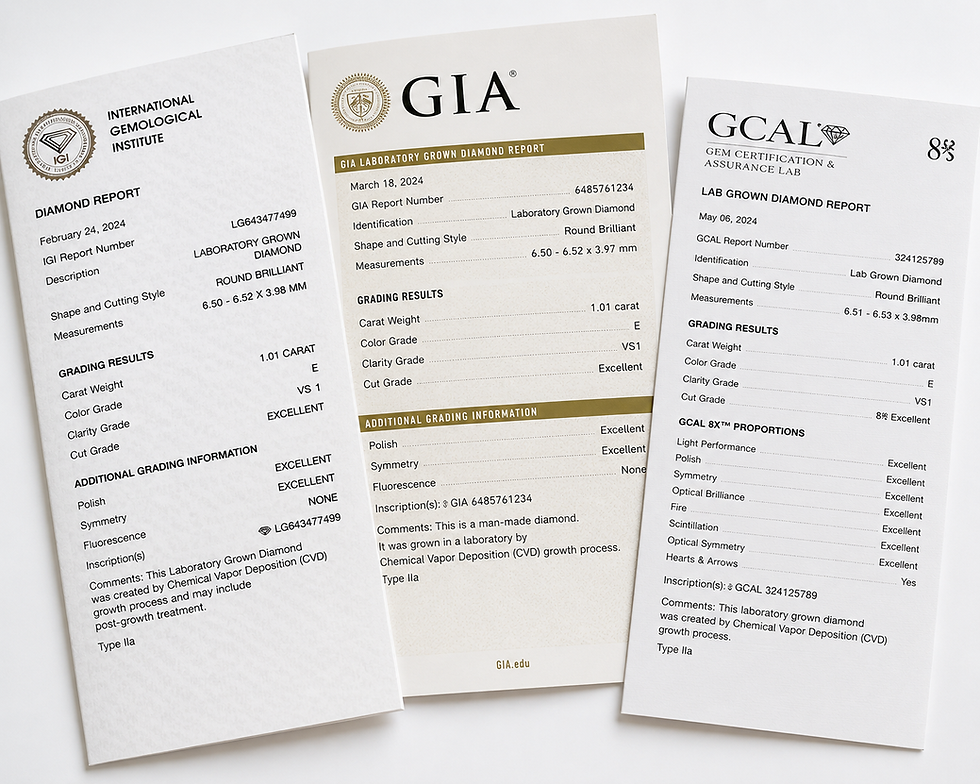
German buyers tend to be quality-conscious. Retailers and their customers expect documentation. The three certifications that carry full market acceptance in Germany and across the EU are:
IGI (International Gemological Institute) — Headquartered in Antwerp with labs globally, IGI is the dominant certification body for lab-grown diamonds worldwide. Their grading reports are thorough, consistent, and widely trusted by German retailers and their end customers. This is the most commonly requested certification we supply.
GIA (Gemological Institute of America) — GIA is the global standard-bearer for diamond grading. German luxury retail and certain high-end channels often prefer GIA-certified stones. GIA has expanded its lab-grown diamond grading in recent years.
GCAL (Gem Certification and Assurance Lab) — GCAL is known for its guarantee-backed certificates and is growing in recognition, particularly among buyers who want an additional assurance layer beyond grade.
At Nishal Gems, we stock and supply IGI, GIA, and GCAL certified diamonds. Most of our European wholesale buyers default to IGI for their lab-grown inventory.
For jewellery retail, certified diamonds are generally the preferred choice because certification supports authenticity, insurance, resale and customer confidence.
The Import Process: Step by Step
Here's what actually happens when you source lab-grown diamonds from Surat and import them into Germany.
Step 1: Agree on the order with your supplier
This includes confirming carat weights, shapes, cuts, colour and clarity grades, certifications, and pricing per carat. At this stage, your supplier should also confirm availability from their production inventory. We typically share a full availability list in Excel or via a B2B portal for our wholesale clients.
Step 2: Receive a commercial invoice and packing list
Your supplier will generate a commercial invoice that accurately describes the goods (HS code, value per piece, total value, country of origin). This document is critical for customs clearance. At Nishal Gems, we prepare export documentation in line with Indian customs requirements to help our international buyers complete the import process smoothly.
Step 3: Confirm export documentation from India
India has its own export clearance process. Diamonds exported from India require an export shipping bill processed through Indian Customs. India's GJEPC (Gems and Jewellery Export Promotion Council) oversees the sector, and licensed exporters like Nishal Gems handle this routinely.
You'll also receive a Certificate of Origin confirming the goods originated in India. This supports any applicable trade preferences under EU-India arrangements.
Step 4: Choose your shipping method
For most wholesale diamond shipments, the two dominant carriers for India-to-Germany are:
FedEx International Priority — Transit: 3–5 business days from Surat to major German cities
DHL Express International — Transit: 3–5 business days, strong customs pre-clearance capabilities
We typically arrange insured shipments through trusted international carriers such as DHL Express and FedEx International Priority, depending on the destination and shipment requirements. Tracking information is shared with buyers once the shipment has been dispatched.

Step 5: Customs clearance in Germany
Your shipment arrives at the import point (Frankfurt airport handles the majority of high-value freight into Germany). German customs (Bundeszollverwaltung) will process the commercial invoice and packing list, assess the value, and calculate VAT at 19%.
The VAT payable depends on the customs valuation and applicable regulations. Businesses registered for VAT may generally recover eligible input VAT through their VAT returns.
Step 6: Delivery to your premises
Once cleared, the shipment is delivered by the carrier to your specified address. For most German retailers, this is their shop or office address. Some buyers use a freight forwarder or customs broker for the clearance process, which can be helpful if you're new to importing and want someone else to handle the paperwork.
Taxes Summary for German Diamond Importers
Tax / Duty | Rate | Notes |
EU Import Duty (HS 7104.20) | 0% | Lab-grown diamonds attract zero tariff |
German VAT (Mehrwertsteuer) | 19% | Applied at customs on declared value; recoverable if VAT-registered |
Customs Broker Fee | Variable | ~€50–150 per shipment if using a broker |
Insurance | 0.5–1% of value | Required for high-value shipments |
Shipping Timelines from Surat to Germany
Surat to Germany by express courier (FedEx or DHL): Typically 3–5 business days, subject to customs clearance and carrier operations.
We typically dispatch within 24–48 hours of confirming an order and receiving payment or deposit, assuming the stones are in production inventory. For custom-cut or specific specification orders, production lead time adds 7–14 days before dispatch.
Why Source from Surat?

Surat, India is responsible for cutting and polishing over 90% of the world's diamonds. This reflects Surat's long-established role in the global diamond manufacturing industry.
Many major diamond retailers source diamonds that have passed through Surat at some stage of the supply chain.
Here's why sourcing directly from a Surat manufacturer matters for a German buyer:
Price. A diamond that travels from a Surat factory to a Mumbai aggregator to a Dubai distributor to an Antwerp broker and finally to a German retailer has passed through four sets of margin. Each margin is real money added to the cost of the stone. Direct sourcing can reduce or eliminate several intermediary markups, depending on the supply chain.
Speed. When you're connected directly to a manufacturer, your order enters their production or availability pipeline without the queue-jumping, miscommunication, or availability confusion that comes from buying through intermediaries.
Specification accuracy. If you want 1.00ct, E, VVS2, round brilliant, IGI certified, you can specify those requirements directly with the manufacturer, subject to availability and production.
Factory-direct relationships. Over time, direct relationships with a manufacturer give you flexibility — custom specification orders, consistent quality control, and a partner who understands your market.
Why Nishal Gems for German Wholesale Buyers
We've been in this business since 1992. Ashok Bhansali started Nishal Gems in Mahidharpura, Surat's core diamond district, and the business has been built around long-term wholesale relationships with international buyers.
A few specifics about what we offer:
Stock: We maintain a large inventory of certified lab-grown diamonds across a wide range of shapes, sizes, colours and clarity grades.
Certifications: IGI, GIA, and GCAL. All stones come with valid grading reports.
Types: CVD and HPHT, both available across all grades. We can advise on which type suits your market positioning and price point.
Minimum order: We work with serious wholesale buyers and private label brands. We don't have a fixed minimum, but orders typically start from 5–10 stones per specification. We can discuss your requirements directly.
Communication: We are comfortable working with German buyers via email, WhatsApp, and video call. We've found most European buyers prefer WhatsApp for day-to-day communication and email for formal documentation.
Samples: For buyers who want to evaluate quality before committing to larger orders, we can discuss sample arrangements.
Common Mistakes German Buyers Make When Importing Diamonds
We've seen enough first-time importers make the same mistakes that it's worth listing them out.
Undervaluing on the invoice. Some buyers ask suppliers to list a lower value on the commercial invoice to reduce VAT. This is customs fraud. German customs authorities are experienced with high-value goods, and the risk of seizure, penalty, and reputational damage is not worth it. Always declare accurate values.
Skipping insurance. A €15,000 shipment of diamonds being shipped uninsured through standard freight is a liability. Carriers have maximum liability limits that are a fraction of the shipment value. We strongly recommend insuring all high-value shipments.
Buying uncertified stones. Any supplier offering significant discounts for "no-certificate" diamonds is not a supplier you want to work with. The certificate is the stone's identity document.
Using sea freight or economy courier. Standard freight is not appropriate for diamond shipments from a security, tracking, or insurance standpoint. Use express carriers with explicit high-value declarations.
Not checking HS codes with a customs broker. If you're importing a mixed parcel of lab-grown and mined diamonds (some buyers do), HS codes differ and so do duty rates. Check with a German customs broker or freight forwarder who handles gemstones regularly.


Comments