
Why US Jewelry Retailers Are Switching to Lab-Grown Diamond Engagement Collections
Three years ago, a retailer asking about lab-grown engagement inventory at a trade show would typically get a small section of a booth and a cautious conversation. Today, that same question opens some of the most direct sourcing discussions in the industry.
Something shifted. If you're running a jewelry store in the US — or evaluating whether to add a lab-grown engagement collection — it's worth understanding what actually changed and how retailers who've made the move are approaching it.
The Short Version
US jewelry retailers are adding lab-grown diamond engagement collections in response to measurable consumer interest, improved certification confidence, and better sourcing access. Some retailers are going all-in; others are adding lab-grown alongside their natural inventory. Both approaches are working in different market contexts.
What's clear is that more retailers are evaluating lab-grown seriously rather than dismissing it — and that evaluation is increasingly landing in favor of at least adding it to the mix.
What Consumer Demand Actually Looks Like Right Now
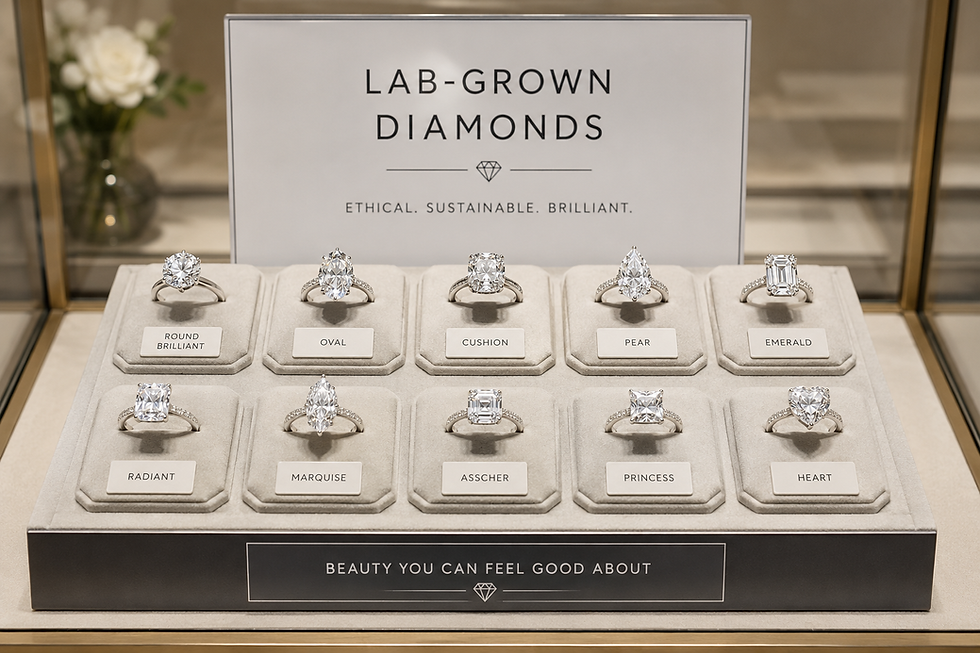
Many retailers we work with report a significant increase in consumers specifically requesting lab-grown diamonds compared to just a few years ago. The profile of that buyer has also changed.
Early on, it was typically younger, tech-forward customers who had done extensive research on their own. That demographic has widened. Retailers are now seeing couples across age groups arrive with prior knowledge of IGI certification, some familiarity with CVD and HPHT processes, and clear questions about what they can get for their budget in each category.
That doesn't mean every customer prefers lab-grown. It means the conversation has become a normal part of the engagement ring purchase for many buyers — and retailers who don't have lab-grown in their case often have to explain why they don't carry it.
Certification Confidence Has Improved Significantly
This was the real barrier for a long time. Not the diamond itself — the explanation around it.
Consumers weren't sure if lab-grown was "real." Retailers weren't confident in how to frame the certification story. The industry hadn't made it particularly easy. That picture has improved substantially.
What changed is the credibility of independent certification. IGI grades lab-grown diamonds to the same 4Cs standard used for mined stones: Cut, Color, Clarity, and Carat. The grading process is independent. The report format is comparable. When a customer looks at an IGI certificate for a lab-grown stone, they're reading the same type of document they'd get for a natural diamond at the same quality tier.
That gives the retailer something concrete to work from — an independent document, not a sales claim. For most buyers who arrive already researching lab-grown, the IGI certificate is the moment the conversation moves from consideration to purchase.
The Economics: What Retailers Are Actually Finding

Lab-grown diamonds are available at a lower price per carat than mined diamonds of equivalent certified quality. The gap varies by shape, size, and grade.
Retailers sourcing directly from manufacturers — rather than through multiple layers of the traditional supply chain — work with a better cost position on certified stones. The closer you are to the manufacturing source, the less margin is absorbed between production and your retail case. That's not specific to lab-grown; it's how direct sourcing works across any category.
The retailers seeing the strongest results share a few things in common: they buy certified inventory, they source from suppliers who provide consistency across parcels, and they treat lab-grown as a genuine part of their collection rather than a temporary addition.
CVD vs HPHT: What You Need to Know Before Ordering
You'll get this question from customers eventually. Here's a clean explanation.
CVD (Chemical Vapour Deposition): A diamond seed is placed in a chamber filled with carbon-rich gas. The gas is energized, carbon atoms deposit onto the seed, and the diamond grows layer by layer. CVD is more commonly used for stones above 1ct and gives manufacturers good control over size and clarity.
HPHT (High Pressure High Temperature): Replicates the geological conditions that form natural diamonds — extreme heat and pressure applied to a carbon source around a diamond seed. HPHT tends to produce very high color grades naturally, which is why it's often specified for D–F color inventory.
Both processes produce real diamonds. Both are certifiable by IGI. For most retail engagement ring collections, the end customer doesn't need to know which process produced their stone. But you should, because it affects what you're ordering and why.
Understanding Value in a Lab-Grown Collection
The strongest retail case for lab-grown isn't built on price alone. It's built on certified quality, consistent supply, and matching the right stone to the right customer.
Retailers who approach lab-grown as a quality and service conversation tend to build more sustainable collections. The customers arriving asking about lab-grown are often already past the price question. They want to know: is it certified, is it real, and can I trust the retailer I'm buying from?
That's a conversation your inventory and your supplier relationship either supports or doesn't. Getting the sourcing right is what makes the retail conversation easy.
How Retailers Are Actually Building Collections
Many retailers add lab-grown alongside their natural diamond offerings rather than replacing them. This gives them the flexibility to serve customers across a range of preferences and budgets without making a binary choice about their entire inventory strategy.
The retailers seeing the strongest results typically start focused rather than broad. Round brilliants and ovals in the 0.75ct to 1.5ct range cover the majority of US engagement ring demand. VS1–VS2 clarity, G–H color is the practical starting tier — eye-clean, well-certified, accessible across most engagement ring budgets.
From there, many expand based on what their specific customer base is asking for. Some add cushions and pears. Some move into higher color grades for clients who prioritize D–F. The starting point is always the same: what are the couples who've already asked about lab-grown in your store actually looking for?
What to Look for in a Supplier

A few non-negotiables worth applying to any supplier you're evaluating.
Certification first, always. Don't take inventory without an IGI or GIA grading certificate. Not a manufacturer's assurance — an independent laboratory document. This is non-negotiable for protecting your retail reputation.
Ask about process. A credible manufacturer will tell you exactly whether their stones are CVD or HPHT and provide documentation. Vagueness here is a red flag.
Understand their supply chain position. Are they a manufacturer, a trader, or something in between? The closer your supplier is to actual production, the more control they have over quality and the less cost is absorbed before it reaches you.
Talk to other retailers they supply. Referrals within the trade carry real weight. A manufacturer with a track record of supplying US retailers at scale should be able to provide references without hesitation.
FAQ
Q1: Why are US jewelry retailers adding lab-grown diamond engagement collections?Many retailers are responding to a measurable increase in consumers specifically requesting lab-grown diamonds. Couples are arriving with prior knowledge of IGI certification and clear preferences. Adding lab-grown gives retailers a credible answer to a question they're already being asked.
Q2: Are lab-grown diamonds profitable for jewelry retailers?
Yes, Retailers sourcing directly from manufacturers work with a stronger cost position on certified stones because intermediary steps are removed. The quality and certification stay the same — the supply chain becomes more efficient.
Q3: What certification should I require when sourcing lab-grown diamonds?
IGI is the widely accepted standard in the US market for lab-grown diamonds. GIA also certifies lab-grown stones. Always require an independent grading certificate before accepting inventory — not a supplier's assurance, an actual laboratory document.
Q4: What is the difference between CVD and HPHT lab-grown diamonds?
CVD grows diamonds from carbon-rich gas in a controlled chamber. HPHT replicates geological pressure and heat around a carbon source. Both produce real, IGI-certifiable diamonds. CVD is more common for larger stones; HPHT tends to produce very high color grades naturally.
Q5: Should I replace my natural diamond inventory with lab-grown, or carry both?Most retailers add lab-grown alongside their natural offerings. The two categories serve different buyer preferences. A combined approach lets you serve a wider range of customers without committing your entire inventory strategy to one category.
Q6: What shapes and sizes should I stock first?
Round brilliants and ovals in the 0.75ct to 1.5ct range cover the majority of US engagement ring demand. VS1–VS2 clarity and G–H color is the practical starting tier — eye-clean, well-certified, and accessible across most engagement ring budgets.
Q7: How do I verify a lab-grown diamond supplier's reliability?
Ask for references from other retailers they supply. Request documentation on their manufacturing process and ask about their certification standards. A credible manufacturer provides all of this without hesitation.
Q8: Do US consumers trust lab-grown diamonds for engagement rings?
Consumer confidence has grown significantly. Buyers who arrive having researched IGI certification are often already decided. The retailer's job is to have the right certified inventory available and the knowledge to back it up.
Q9: What is the advantage of sourcing directly from a manufacturer?
The closer you are to the manufacturing source, the less cost is absorbed between production and your retail case. Direct sourcing also gives you more control over parcel specifications — shape, size, quality tier, certification — and clearer insight into what you're actually buying.
Q10: Can I create a private label lab-grown diamond engagement collection?
Yes, Manufacturers who supply directly to retailers can also work with private label brands — you specify stone parameters and the manufacturer supplies to your requirements. This is a growing segment of the US market among jewelry brands building their own engagement lines.
Q11: Why is Surat, India significant for lab-grown diamond sourcing?
Surat is the primary global manufacturing center for lab-grown diamonds. The cutting, polishing, and certification infrastructure is concentrated there. Sourcing from Surat-based manufacturers means working directly with the people who actually produce the stones.
Q12: What training does my staff need before selling lab-grown diamonds?
Your team needs confidence on three points: lab-grown diamonds are real diamonds with the same carbon structure, IGI certifies them to the same standard as mined stones, and the price difference reflects supply chain economics rather than quality. Clear, calm, consistent — that's the standard.
Q13: How is the consumer conversation around lab-grown engagement rings changing?
Buyers researching lab-grown often arrive with a clear understanding of their preferences — they've compared quality grades, reviewed certifications, and made their own budget calculations. The retailer's role has shifted from educating from scratch to confirming what the buyer already understands and helping them find the right stone.
How Nishal Gems Supports Retailers
Nishal Gems is a Surat-based manufacturer specializing in IGI-certified CVD and HPHT lab-grown diamonds. Established in 1992, we supply loose lab-grown diamonds directly to jewelry retailers, importers, and private label brands across the USA, UK, UAE, Australia, and Hong Kong.
If you're evaluating lab-grown sourcing options and want to understand what direct manufacturer supply looks like in practice — parcel sizes, certification specifications, turnaround times — we're happy to have that conversation.

Preparing for Changing Consumer Preferences
The US engagement ring market has changed — not overnight, but measurably. Retailers adding lab-grown collections today aren't chasing a trend. They're responding to buyers who are already in their stores asking questions that require a thoughtful, informed answer.
Many retailers are choosing to add lab-grown collections alongside their natural diamond offerings to serve a wider range of customer preferences. The strongest position isn't picking a side — it's being equipped to have a credible, honest conversation about both.
The retailers evaluating this seriously right now are building the supplier relationships and inventory knowledge that will serve them well as that demand continues to grow


Comments