
Lab-Grown Diamond Size Chart: Complete MM to Carat Reference Guide (All Shapes, 2026)

Why Diamond Size Measurements Matter — Especially for B2B Buyers
A carat measures weight, not size. This distinction — simple in principle, but commercially significant in practice — is one that every professional diamond buyer, jewellery manufacturer, and retailer needs to fully internalise before making sourcing decisions, setting customer expectations, or building product specifications.
For wholesale diamond buyers ordering loose stones, jewellery manufacturers specifying production requirements, or retailers communicating product dimensions to their customers, the MM measurement is the operative reference — not the carat weight alone. A 1.00ct round brilliant diamond and a 1.00ct emerald cut diamond will present very differently in a setting, even though they weigh identically.
This reference guide from Nishal Gems — one of Surat's established lab-grown diamond manufacturers — provides the complete, professional-grade MM-to-carat conversion data for all standard shapes. It also covers the B2B sourcing implications of size and cut relationship, the consistency advantage of lab-grown production for matching lots, and the certification data points that professional buyers should always reference alongside MM measurements.
FEATURED SNIPPET — CORE DEFINITION A lab-grown diamond carat is a unit of weight: 1 carat = 0.200 grams (200 milligrams). For a round brilliant lab-grown diamond, 1.00 carat corresponds to approximately 6.40–6.50 mm in diameter. Lab-grown diamonds follow the exact same MM-to-carat conversion standards as natural mined diamonds — they are physically, chemically, and optically identical and are graded using identical gemological criteria. |
Section 1: The Science of Diamond Sizing — What Every Buyer Must Know
Carat = Weight. MM = Dimensions. Both Are Essential.
One carat equals exactly 0.200 grams — or 200 milligrams. This is an absolute standard established by the Metric Carat adopted globally in 1907 and confirmed through modern gemological grading. The carat weight of a diamond is determined by precision micro-balancing to four decimal places, then rounded to two decimal places on the grading report.
The millimetre measurement refers to the physical dimensions of the polished stone. For round brilliants, this is the diameter (and depth). For fancy shapes, length × width (and depth) are the operative dimensions. The MM measurement is what physically fits in a setting, what determines face-up visual size on a finger, and what professional buyers specify when ordering for production.
Why Two Diamonds of the Same Carat Can Look Completely Different
Cut quality is the variable that creates the gap between carat weight and visual size. A diamond cut with excessive depth will concentrate mass below the girdle — resulting in a smaller face-up appearance despite a higher carat weight. Conversely, a well-proportioned cut maximises the table surface area visible from above, giving the most visual impact per carat.
For lab-grown diamonds produced through CVD manufacturing, cut parameters can be specified and controlled with greater consistency than in natural diamond production — where the rough crystal's shape imposes constraints on the cutter. This is a practical manufacturing advantage for buyers who need consistent dimensional specifications across production batches.
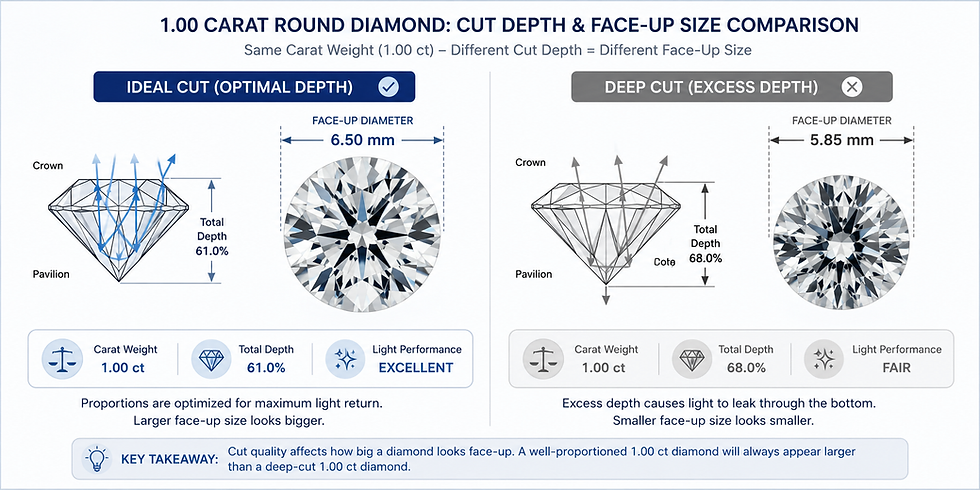
The Specific Gravity Factor
Diamond has a specific gravity of 3.51–3.53 g/cm³. This physical constant means that for any given shape with consistent proportions, the MM-to-carat relationship is predictable — and this is the basis of the size charts in this guide. However, individual stones may vary slightly based on their exact depth percentage and specific proportions, which is why all size charts should be understood as standard estimates based on ideal or well-cut proportions.
Section 2: Round Brilliant Diamond Size Chart — The Complete Reference
The round brilliant is the most popular shape globally and the default reference for all diamond size comparisons. All measurements assume ideal to excellent cut proportions — the standard for professionally manufactured lab-grown diamonds.
ROUND BRILLIANT — FULL MM TO CARAT CHART |
Round Brilliant Cut — Diameter (MM) to Carat Weight | |||
Diameter (MM) | Carat Weight (approx.) | Trade Classification | B2B Use Context |
1.00 mm | 0.005 ct | Micro melee | Pave, micro-pave settings |
1.25 mm | 0.008 ct | Micro melee | High-density pave |
1.50 mm | 0.015 ct | Melee | Pave, accent work |
1.75 mm | 0.025 ct | Melee | Halo, pave borders |
2.00 mm | 0.03 ct | Melee | Standard pave accent |
2.25 mm | 0.045 ct | Melee | Halo applications |
2.50 mm | 0.06 ct | Melee | Accent stones |
2.75 mm | 0.08 ct | Melee | Side stones, halos |
3.00 mm | 0.10 ct | Melee / Small single | Channel set, pave detail |
3.25 mm | 0.14 ct | Small | Side stones |
3.50 mm | 0.17 ct | Small | Three-stone sides |
3.75 mm | 0.21 ct | Small | Side stone, station necklace |
4.00 mm | 0.25 ct | Quarter carat | Common side / accent stone |
4.25 mm | 0.28 ct | Small | Side stones |
4.50 mm | 0.33 ct | Third carat | Stud earrings (pair) |
4.75 mm | 0.40 ct | Mid-small | Stud earrings, side stones |
5.00 mm | 0.50 ct | Half carat | Popular centre / stud size |
5.20 mm | 0.55 ct | Mid | Centre stones, studs |
5.40 mm | 0.65 ct | Mid | Centre stones |
5.75 mm | 0.75 ct | Three-quarter carat | Popular retail centre stone |
6.00 mm | 0.84 ct | Mid | Centre stones |
6.20 mm | 0.90 ct | Near 1ct | Near-carat buyers |
6.40 mm | 1.00 ct | 1 carat | Most popular B2B size |
6.50 mm | 1.00 ct | 1 carat | 1ct range upper |
6.80 mm | 1.25 ct | Mid premium | Premium retail |
7.00 mm | 1.30 ct | Mid premium | Premium centre stones |
7.30 mm | 1.50 ct | 1.5 carat | High-demand premium size |
7.75 mm | 1.75 ct | Premium | Luxury centre stones |
8.00 mm | 2.00 ct | 2 carat | Premium-luxury |
8.20 mm | 2.10 ct | Luxury | Statement pieces |
8.70 mm | 2.50 ct | Luxury | Statement centre stones |
9.10 mm | 3.00 ct | Luxury | High-end bespoke |
9.75 mm | 3.50 ct | Ultra luxury | Bespoke/collector |
10.25 mm | 4.00 ct | Ultra luxury | Collector stones |
10.75 mm | 4.50 ct | Ultra luxury | Special order |
11.00 mm | 5.00 ct | Ultra luxury | Bespoke special order |
Note: All measurements represent averages for ideal/excellent cut proportions. Individual stones may vary by ±0.05–0.10mm depending on specific depth percentage and girdle width.
Section 3: Fancy Shape Diamond Size Charts — All Shapes
For non-round shapes — referred to as "fancy shapes" in the trade — the MM measurement is expressed as length × width (L×W) rather than a single diameter. The face-up surface area of fancy shapes is larger per carat than round brilliants for elongated cuts, which is why oval, pear, and marquise diamonds appear larger than round diamonds of the same carat weight.
B2B SIZING PROTOCOL FOR FANCY SHAPES When ordering fancy shape loose lab-grown diamonds for production, specify L×W ratio alongside carat weight. A 1.00ct oval ordered at 8×5.5mm will appear significantly different from a 1.00ct oval ordered at 9×6mm. Specifying the MM dimensions — not carat weight alone — ensures the finished jewellery piece meets the intended visual design. At Nishal Gems, bespoke specifications can be discussed with our trade team before order placement. |
Oval Diamond Size Chart
Oval diamonds have approximately 10–15% larger face-up surface area than round brilliants of the same carat weight. Standard length-to-width ratio: 1.30–1.50:1.
Oval Cut — L×W (MM) to Carat Weight | |||
L × W (MM) | Carat Weight | L:W Ratio | Visual Character |
5 × 3.5 mm | 0.25 ct | 1.43:1 | Classic oval proportion |
6 × 4 mm | 0.40 ct | 1.50:1 | Elegant elongated |
7 × 5 mm | 0.75 ct | 1.40:1 | Popular mid-size |
7.5 × 5.5 mm | 1.00 ct | 1.36:1 | Standard 1ct oval |
8 × 5.5 mm | 1.00 ct | 1.45:1 | Elongated 1ct oval |
8 × 6 mm | 1.25 ct | 1.33:1 | Balanced 1.25ct |
8.5 × 6 mm | 1.50 ct | 1.42:1 | Popular premium size |
9 × 6 mm | 1.50 ct | 1.50:1 | Classic elongated 1.5ct |
9.5 × 7 mm | 2.00 ct | 1.36:1 | Premium 2ct |
10 × 7 mm | 2.00 ct | 1.43:1 | Elongated 2ct |
10.5 × 7.5 mm | 2.50 ct | 1.40:1 | Statement 2.5ct |
11 × 8 mm | 3.00 ct | 1.38:1 | Luxury 3ct |
12 × 8.5 mm | 4.00 ct | 1.41:1 | Ultra premium |
Cushion Cut Diamond Size Chart
Cushion cuts feature rounded corners with a square-to-rectangular outline. Standard aspect ratio for cushion: 1.00–1.10:1 for square; up to 1.20:1 for rectangular cushion.
Cushion Cut — MM to Carat Weight (Square / Near-Square) | |||
MM Size | Carat Weight | Shape Profile | Common Use |
3.50 × 3.50 mm | 0.20 ct | Square cushion | Accent stones |
4.00 × 4.00 mm | 0.30 ct | Square cushion | Side / accent |
4.50 × 4.50 mm | 0.50 ct | Square cushion | Three-stone side |
5.00 × 5.00 mm | 0.75 ct | Square cushion | Centre / side stone |
5.50 × 5.50 mm | 1.00 ct | Square cushion | Centre stone 1ct |
6.00 × 5.50 mm | 1.25 ct | Near-square | Popular centre |
6.50 × 6.00 mm | 1.50 ct | Near-square | Premium centre |
7.00 × 6.50 mm | 2.00 ct | Near-square | Luxury centre |
7.50 × 7.00 mm | 2.25 ct | Near-square | Premium statement |
8.00 × 7.50 mm | 3.00 ct | Rectangular cushion | Luxury |
9.00 × 8.00 mm | 4.00 ct | Rectangular | Ultra luxury |
Princess Cut Diamond Size Chart
Princess cuts are square with sharp corners. They are the second most popular shape after round and present slightly smaller face-up per carat than rounds due to their depth profile.
Princess Cut — MM to Carat Weight | ||
MM Size | Carat Weight | Notes |
3.25 × 3.25 mm | 0.25 ct | Accent / side stone range |
4.00 × 4.00 mm | 0.40 ct | Side stones, small centres |
4.50 × 4.50 mm | 0.50 ct | Half-carat standard |
5.00 × 5.00 mm | 0.75 ct | Three-quarter carat |
5.50 × 5.50 mm | 1.00 ct | Standard 1ct princess |
6.00 × 6.00 mm | 1.25 ct | Premium 1.25ct |
6.50 × 6.50 mm | 1.50 ct | Popular premium size |
6.75 × 6.75 mm | 1.75 ct | Premium centre stone |
7.00 × 7.00 mm | 2.00 ct | Luxury 2ct princess |
7.50 × 7.50 mm | 2.50 ct | Statement 2.5ct |
8.00 × 8.00 mm | 3.00 ct | Luxury statement |
8.50 × 8.50 mm | 3.50 ct | Ultra luxury |
9.50 × 9.50 mm | 5.00 ct | Ultra premium / collector |
Emerald Cut Diamond Size Chart
Emerald cuts feature step-cut facets with a rectangular outline and trimmed corners. Due to their shallow crown and large table, they appear larger face-up per carat than most other shapes and emphasise clarity.
Emerald Cut — L×W (MM) to Carat Weight | |||
L × W (MM) | Carat Weight | L:W Ratio | Visual Notes |
5.00 × 3.50 mm | 0.35 ct | 1.43:1 | Classic proportion |
5.50 × 4.00 mm | 0.50 ct | 1.38:1 | Half carat emerald |
6.00 × 4.50 mm | 0.75 ct | 1.33:1 | Three-quarter carat |
6.50 × 4.75 mm | 1.00 ct | 1.37:1 | Standard 1ct emerald |
7.00 × 5.00 mm | 1.00 ct | 1.40:1 | Elongated 1ct |
7.50 × 5.50 mm | 1.50 ct | 1.36:1 | Premium emerald |
8.00 × 6.00 mm | 2.00 ct | 1.33:1 | Luxury centre stone |
8.50 × 6.50 mm | 2.50 ct | 1.31:1 | Statement emerald |
9.00 × 7.00 mm | 3.00 ct | 1.29:1 | Luxury 3ct |
10.00 × 8.00 mm | 4.00 ct | 1.25:1 | Ultra premium |
10.50 × 8.50 mm | 5.00 ct | 1.24:1 | Collector / bespoke |
Pear Diamond Size Chart
Pear shapes combine the brilliance of a round with the elongation of a marquise. They appear larger face-up per carat than rounds and are highly popular for pendants and statement pieces. Standard ratio: 1.50–1.75:1.
Pear Cut — L×W (MM) to Carat Weight | ||
L × W (MM) | Carat Weight | L:W Ratio |
5 × 3 mm | 0.25 ct | 1.67:1 |
6 × 4 mm | 0.50 ct | 1.50:1 |
7 × 5 mm | 0.75 ct | 1.40:1 |
7.7 × 5.7 mm | 1.00 ct | 1.35:1 |
8 × 5.5 mm | 1.00 ct | 1.45:1 |
8.5 × 6.5 mm | 1.50 ct | 1.31:1 |
9 × 7 mm | 2.00 ct | 1.29:1 |
10 × 6 mm | 1.75 ct | 1.67:1 |
10 × 8 mm | 2.50 ct | 1.25:1 |
12 × 8 mm | 3.00 ct | 1.50:1 |
14 × 8 mm | 4.00 ct | 1.75:1 |
15 × 9 mm | 5.00 ct | 1.67:1 |
Radiant Cut Diamond Size Chart
Radiant cuts combine the elegant lines of emerald shape with the brilliant-cut faceting of a round. Available in square and rectangular proportions, they deliver exceptional fire and brilliance.
Radiant Cut — MM to Carat Weight | ||
MM Size | Carat Weight | Profile |
4.50 × 4.50 mm | 0.50 ct | Square radiant |
5.00 × 5.00 mm | 0.75 ct | Square radiant |
5.50 × 5.50 mm | 1.00 ct | Square radiant 1ct |
6.00 × 5.00 mm | 1.00 ct | Rectangular 1ct |
6.50 × 5.50 mm | 1.50 ct | Rectangular 1.5ct |
7.00 × 5.50 mm | 1.75 ct | Rectangular premium |
7.00 × 6.50 mm | 2.00 ct | Near-square luxury |
8.00 × 6.00 mm | 2.50 ct | Rectangular statement |
8.00 × 7.50 mm | 3.00 ct | Near-square luxury |
9.00 × 7.50 mm | 4.00 ct | Rectangular ultra |
9.50 × 8.00 mm | 5.00 ct | Statement / bespoke |
Marquise Diamond Size Chart
Marquise cuts are elongated with pointed ends — maximising surface area per carat more than any other shape. They create an elongating effect on the finger. Standard ratio: 1.75–2.25:1.
Marquise Cut — L×W (MM) to Carat Weight | ||
L × W (MM) | Carat Weight | L:W Ratio |
6 × 3 mm | 0.25 ct | 2.00:1 |
8 × 4 mm | 0.50 ct | 2.00:1 |
9 × 4.5 mm | 0.75 ct | 2.00:1 |
10 × 5 mm | 1.00 ct | 2.00:1 |
11 × 5.5 mm | 1.25 ct | 2.00:1 |
12 × 6 mm | 1.50 ct | 2.00:1 |
12.5 × 6.25 mm | 1.75 ct | 2.00:1 |
13 × 6.5 mm | 2.00 ct | 2.00:1 |
14 × 7 mm | 2.50 ct | 2.00:1 |
15 × 7 mm | 3.00 ct | 2.14:1 |
16.5 × 8.25 mm | 4.00 ct | 2.00:1 |
17 × 8.5 mm | 5.00 ct | 2.00:1 |
Asscher Cut Diamond Size Chart
Asscher cuts are square with deep step-cut facets creating a distinctive "hall of mirrors" optical effect. Proportions follow the same MM standards as princess cuts, with deeper pavilion.
Asscher Cut — MM to Carat Weight | |
MM Size | Carat Weight |
3.25 × 3.25 mm | 0.25 ct |
4.50 × 4.50 mm | 0.50 ct |
5.00 × 5.00 mm | 0.75 ct |
5.50 × 5.50 mm | 1.00 ct |
6.00 × 6.00 mm | 1.25 ct |
6.50 × 6.50 mm | 1.50 ct |
6.70 × 6.70 mm | 1.75 ct |
7.00 × 7.00 mm | 2.00 ct |
7.50 × 7.50 mm | 2.50 ct |
8.00 × 8.00 mm | 3.00 ct |
8.50 × 8.50 mm | 3.50 ct |
9.00 × 9.00 mm | 4.00 ct |
9.50 × 9.50 mm | 5.00 ct |
Heart Diamond Size Chart
Heart shapes are a modification of the pear cut. Measured at their widest point, they require skilled cutting to achieve symmetrical lobes and a clean cleft. Standard ratio: 0.90–1.10:1 (near-square face-up).
Heart Cut — MM (Width) to Carat Weight | ||
Width (MM) | Carat Weight | Notes |
4.00 mm | 0.25 ct | Small accent / pendant |
5.00 mm | 0.50 ct | Half-carat heart |
5.75 mm | 0.75 ct | Three-quarter carat |
6.50 mm | 1.00 ct | Standard 1ct heart |
7.00 mm | 1.25 ct | Premium heart |
7.50 mm | 1.50 ct | Luxury heart stone |
8.00 mm | 2.00 ct | Statement heart |
9.00 mm | 3.00 ct | Luxury statement |
10.00 mm | 4.00 ct | Ultra luxury / bespoke |
Section 4: Cross-Shape Size Comparison at Key Carat Weights
This is the comparison table most useful for wholesale buyers and jewellery manufacturers: comparing the face-up dimensions of the same carat weight across all major shapes.
FACE-UP SIZE COMPARISON — 1.00 CARAT ACROSS ALL SHAPES |
Shape | Dimensions (MM) | Face-Up Area (approx.) | Appears Larger Than Round? |
Round Brilliant | 6.40–6.50 (diameter) | ~33 mm² | — (benchmark) |
Oval | 7.5–8 × 5.5–6 | ~35–38 mm² | Yes — 10–15% larger |
Marquise | 10 × 5 | ~37–39 mm² | Yes — largest face-up |
Pear | 7.7–8 × 5.5–5.7 | ~33–36 mm² | Yes — elongated effect |
Radiant (square) | 5.5 × 5.5 | ~30 mm² | No — slightly smaller |
Princess (square) | 5.5 × 5.5 | ~30 mm² | No — slightly smaller |
Cushion (square) | 5.5 × 5.5 | ~30 mm² | No — similar or slightly smaller |
Emerald | 6.5–7 × 4.75–5 | ~31–33 mm² | Similar — appears longer |
Asscher | 5.5 × 5.5 | ~30 mm² | No — similar to princess |
Heart | 6.5 (width) | ~32 mm² | Similar to round |
Key insight: Elongated shapes (oval, marquise, pear) deliver larger apparent face-up size per carat than compact shapes (round, princess, asscher). For retailers communicating value to customers, this face-up size advantage is a meaningful product positioning point.

Section 5: Melee Diamond Size Chart — The B2B Buyer's Reference
Melee diamonds — typically defined as stones below 0.20 carats — are the backbone of pave settings, halo designs, and multi-stone jewellery manufacturing. For wholesale buyers ordering melee parcels, the MM measurement is the primary specification tool.
MELEE ROUND BRILLIANT — STANDARD SIZE REFERENCE |
MM Diameter | Carat Weight | Trade Size Name | Typical Application |
1.00 mm | 0.005 ct | Micro melee | Micro pave — fine jewellery |
1.10 mm | 0.0075 ct | Micro melee | High-density pave settings |
1.20 mm | 0.009 ct | Micro melee | Precision pave work |
1.25 mm | 0.01 ct | Micro melee | Fine halo work |
1.50 mm | 0.015 ct | Standard melee | Common pave / accent |
1.75 mm | 0.025 ct | Standard melee | Halo borders, pave margins |
2.00 mm | 0.03 ct | Standard melee | Universal pave accent |
2.25 mm | 0.045 ct | Standard melee | Larger pave, halo side |
2.50 mm | 0.06 ct | Large melee | Accent stones, station |
2.75 mm | 0.08 ct | Large melee | Side stones, station necklace |
3.00 mm | 0.10 ct | Upper melee / small single | Three-stone sides, channel set |
MELEE SOURCING ADVANTAGE — LAB-GROWN Lab-grown melee diamonds offer a critical manufacturing advantage over natural melee: colour consistency across parcels. In natural melee supply chains, colour distribution within a single parcel can vary significantly. CVD lab-grown melee production allows manufacturers to maintain tighter colour windows — ensuring visual uniformity across pave settings and halo designs. This is one of the most practically important quality arguments for professional jewellery manufacturers sourcing from lab-grown producers. |
Section 6: How to Use the Size Chart for Professional B2B Procurement
Step 1: Always Specify MM Alongside Carat Weight
A purchase order that reads "50 × 1.00ct oval lab-grown diamonds, IGI certified" is incomplete. A professional purchase order reads: "50 × 1.00ct oval lab-grown diamonds, dimensions 7.5–8.0 × 5.5–6.0 mm, D-F colour, VS1–VS2 clarity, IGI certified, CVD, Excellent cut." The MM specification eliminates interpretation variance and ensures the delivered stones fit the intended setting dimensions.
Step 2: Use Face-Up Size — Not Carat Weight — for Visual Comparisons
When briefing jewellery designers, communicating with end retailers, or describing stones to customers, lead with MM measurements and face-up size. A 1.50ct oval at 9×6mm conveys the physical reality of the stone; a "1.50 carat oval" leaves the dimensional interpretation to the listener. The MM number is unambiguous.
Step 3: For Matching Lots, Request Batch Consistency Documentation
For orders requiring matched stones — earring pairs, graduated necklace sets, identical tennis bracelet stones — request batch consistency documentation from the manufacturer. Reputable lab-grown diamond producers can demonstrate grading consistency across production batches. At Nishal Gems, batch sampling is available before large order commitment for bespoke or matched stone requirements.
Step 4: Cross-Reference MM with the IGI Grading Report
Every IGI grading report documents the stone's measurements to the hundredth of a millimetre. When a certified stone arrives, the physical measurement (taken with a diamond gauge or digital calliper) should align with the IGI-documented dimensions. Any discrepancy of more than ±0.05mm should be flagged with the supplier before the stone is set.
Step 5: Understand the Depth Percentage
A stone's MM footprint (diameter or L×W) is only half the dimensional picture. Depth percentage — the depth divided by average diameter or width — determines how deep the stone sits in the setting. An ideal-cut round brilliant has a depth percentage of 59–62.3%. A stone outside this range may require a custom setting depth or may fit differently from standard mounting. Always confirm depth percentage alongside L×W when ordering for production.
Section 7: Common Sizing Mistakes Diamond Buyers Make
Mistake 1: Ordering by Carat Weight Alone
The most pervasive and costly mistake. A 2.00ct round ordered without MM specification could deliver a stone ranging from 7.80mm to 8.30mm in diameter depending on its depth profile. For manufacturers with fixed setting dimensions, this variance creates rework costs and production delays. Always specify MM alongside carat weight.
Mistake 2: Not Accounting for Shape Differences in Setting Design
A design specification calling for a "1ct centre stone" without specifying the shape will receive stones of dramatically different footprints — a 1ct round is 6.5mm diameter; a 1ct marquise is 10×5mm. Settings designed for one shape are not interchangeable with another. MM specifications must be aligned with the setting design from the first stage of the production brief.
Mistake 3: Comparing Stones Visually Without Reference to MM
Evaluating stones visually — or from photographs — without confirming MM dimensions creates systematic bias toward well-lit or well-proportioned stones. The MM measurement, alongside depth percentage, is the objective basis for size comparison. Always obtain the grading report or request digital calliper measurements before visual assessment of loose stones.
Mistake 4: Ignoring Depth When Specifying Melee
In melee sourcing, depth percentage variation affects both the brilliance of the finished pave work and the physical height of stones above the setting surface. Melee ordered by MM only, without attention to depth, can result in inconsistent light performance across a pave field. Request depth percentage ranges alongside MM diameter when sourcing melee for precision pave work.
Mistake 5: Expecting Natural and Lab-Grown to Have Different Size Charts
They do not. Lab-grown diamonds have the same specific gravity (3.51–3.53 g/cm³), the same crystal structure, and the same gemological properties as natural diamonds. The MM-to-carat conversion is identical. Any supplier claiming different size charts for lab-grown stones is misinformed. The data in this guide applies to both.
Section 8: Certification and Measurements — What the IGI Report Tells You
The IGI grading report for a lab-grown diamond documents the following measurement data alongside the standard 4Cs:
IGI Report Field | What It Documents | Why It Matters for Buyers |
Shape and Cut | Shape description + cut grade | Confirms shape specification and cut quality |
Measurements | L × W × Depth (to 0.01mm) | Physical dimensional confirmation — cross-reference with your spec |
Carat Weight | Weight to 0.01ct | Billing and valuation basis |
Table % | Table diameter as % of average diameter | Indicates face-up proportion and brilliance profile |
Depth % | Total depth as % of average diameter | Indicates face-up vs buried carat ratio |
Crown Angle | Crown facet angle in degrees | Affects brilliance and fire balance |
Pavilion Angle | Pavilion facet angle in degrees | Critical for light return efficiency |
Girdle | Thin to Thick — affects diameter consistency | Very thick girdle can inflate carat with less face-up |
Culet | None to large | Affects centre appearance |
Growth Method | CVD or HPHT — explicitly stated | Mandatory disclosure for lab-grown certification |
PROFESSIONAL BUYER TIP When evaluating a loose lab-grown diamond's value for face-up size versus carat weight, look at Table % and Depth % on the IGI report before examining the physical stone. A stone with 64% table and 61% depth will deliver optimal visual size per carat. A stone with 57% table and 68% depth is burying carat weight in depth — appearing smaller than its weight suggests. |
Frequently Asked Questions — Diamond Size Chart
Q1: What size is a 1 carat lab-grown diamond in mm?
A 1 carat round brilliant lab-grown diamond typically measures 6.40–6.50 mm in diameter, assuming ideal or excellent cut proportions. For fancy shapes, a 1 carat oval is approximately 7.5–8 × 5.5–6 mm; a 1 carat princess is approximately 5.5 × 5.5 mm; a 1 carat emerald is approximately 6.5–7 × 4.75–5 mm. Lab-grown and natural diamonds of the same carat weight have identical MM measurements.
Q2: Are lab-grown diamond size charts the same as natural diamond charts?
Yes. Lab-grown diamonds have the same specific gravity (3.51–3.53 g/cm³), the same crystal structure (cubic carbon), and the same gemological properties as natural mined diamonds. The MM-to-carat conversion is physically identical. IGI grading reports for lab-grown diamonds document measurements using the same system as natural diamond reports.
Q3: What is the mm size of a 0.50 carat round brilliant diamond?
A 0.50 carat (half-carat) round brilliant diamond measures approximately 5.00 mm in diameter for an ideal-cut stone. The range for well-cut stones is typically 4.95–5.10 mm. Stones cut with excessive depth may measure as small as 4.80 mm at 0.50 carat, while shallow-cut stones may reach 5.20 mm at the same weight.
Q4: What is the mm size of a 2 carat round diamond?
A 2 carat round brilliant diamond typically measures approximately 8.00–8.20 mm in diameter for ideal cut proportions. This compares to 6.40–6.50 mm for a 1 carat round — demonstrating that doubling the carat weight increases the diameter by only approximately 25–28%, because carat weight scales with volume (a cubic relationship).
Q5: Which diamond shape looks biggest for the same carat weight?
The marquise cut has the largest face-up surface area per carat of any standard diamond shape, followed closely by the oval and pear cuts. These elongated shapes can appear 10–25% larger face-up than a round brilliant of identical carat weight. Compact shapes like the princess, asscher, and cushion square present a similar or slightly smaller face-up area versus a round of the same carat weight.
Q6: What is the mm size of melee diamonds?
Melee diamonds are typically 1.00–3.00 mm in diameter for round brilliants, corresponding to approximately 0.005–0.10 carats per stone. Standard commercial melee falls in the 1.50–2.50 mm range (approximately 0.015–0.06 carats). Micro melee used in precision pave work ranges from 1.00–1.25 mm diameter (0.005–0.01 carats per stone).
Q7: How do I convert diamond mm to carats?
For round brilliants, the standard conversion formula is: Carat weight ≈ (Diameter mm)³ × 0.0061. For example, a 6.5mm diameter round: 6.5³ × 0.0061 = 274.625 × 0.0061 ≈ 1.68ct (approximately). This formula assumes standard ideal-cut proportions. Actual carat weight depends on the stone's specific depth percentage. For non-round shapes, different multipliers apply — consult the shape-specific charts in this guide.
Q8: Does the diamond's cut affect its mm size?
Yes, significantly. Two diamonds of identical carat weight can have meaningfully different MM measurements depending on their cut proportions. A deeply cut diamond concentrates mass in the pavilion — reducing face-up diameter despite the same weight. An ideal-cut diamond maximises table diameter for the given carat weight. For round brilliants, ideal cut proportions produce the largest face-up diameter per carat; depth percentages above 64% progressively reduce the visible diameter at any carat weight.
Q9: What is the standard oval diamond size for 1.5 carats?
A 1.5 carat oval diamond with standard proportions (length-to-width ratio 1.35–1.50:1) typically measures approximately 8.5 × 6.0 mm to 9 × 6.0 mm. The exact dimensions depend on the specific L:W ratio chosen — a more elongated oval (1.50:1) will measure longer and narrower than a rounder oval (1.35:1) of the same carat weight.
Q10: Where can I source certified lab-grown diamonds by exact MM specification?
Nishal Gems, based in Surat, India, supplies IGI-certified loose lab-grown diamonds to B2B buyers with full MM specification capability. Our bespoke service allows buyers to specify exact MM dimensions, colour, clarity, carat range, and growth method (CVD or HPHT) for custom production requirements. Contact our trade team at nishalgems.com/contact or via WhatsApp at +91 9898133032 to discuss your specifications.
Interested in sourcing CVD lab-grown diamonds? contact our team to discuss your requirements.
Related reading:


Comments