
Best Lab-Grown Diamond Shapes for 2 Carat Engagement Rings in 2026

Two carats is a statement. It is the size that commands attention across a room, photographs beautifully in every light, and sits on the hand with quiet, undeniable confidence. And in 2026, more engagement ring buyers than ever are choosing lab-grown diamonds to reach this milestone — accessing stones of exceptional size, certification, and brilliance that simply would not have been possible at the same budget a few years ago.
But here is what many buyers do not realise: at 2 carats, the shape of the diamond matters as much as the stone itself. The shape determines how large the diamond appears on the hand, how much light it returns, how it wears over a lifetime, and ultimately — how it feels to the person wearing it every single day.

Why Lab-Grown Diamonds Have Changed the 2 Carat Conversation in 2026
A lab-grown diamond is not a different category of stone. It is a diamond — chemically, physically, and optically identical to a natural diamond, grown using advanced technology that replicates the conditions under which diamonds form in the earth.
Every lab-grown diamond at Nishal Gems carries an IGI certificate — the same internationally recognised grading report that documents cut, colour, clarity, and carat weight with full independent authority.
In 2026, lab-grown diamond technology has reached a level of precision and consistency that makes every stone indistinguishable from its natural counterpart — in brilliance, in durability, and in the way it looks on the hand on an ordinary Tuesday twenty years from now.
At 2 carats, a lab-grown diamond gives buyers access to an exceptional stone at a price point that allows them to prioritise what genuinely matters: an Excellent cut grade, a higher colour, better clarity, and a setting that complements the stone perfectly. This is not a compromise. It is a choice — made with knowledge, intention, and a certificate to back it up.

The 7 Best Shapes for a 2 Carat Lab-Grown Engagement Ring in 2026
Shape 1 — Round Brilliant: The Timeless Standard
The round brilliant is the most mathematically optimised diamond shape in existence. Its 57 or 58 facets are precisely engineered to return the maximum amount of light to the eye — producing the fire, scintillation, and brightness that most people picture when they think of a diamond.
At 2 carats, a round brilliant is immediately impressive. It sits symmetrically on the finger, complements every hand shape, and works beautifully in every setting from a classic four-prong solitaire to a diamond-pavé halo. In 2026, the round brilliant remains the single most requested shape at Nishal Gems — a fact that has not changed in decades and shows no sign of changing.
Best for: The buyer who wants timeless, maximum brilliance and a stone that will never feel dated.
Setting recommendation: Four-prong or six-prong solitaire in platinum or white gold to maximise light entry. A thin pavé band adds elegance without competing with the centre stone.

Shape 2 — Oval Cut: The 2026 Favourite
The oval cut has held its position as one of the most requested engagement ring shapes for several years running — and in 2026, it shows no signs of stepping aside. At 2 carats, its elongated outline makes the diamond appear significantly larger than a round brilliant of the same carat weight, while its curved shape flatters virtually every hand and finger length.
Oval cuts also produce exceptional brilliance — nearly comparable to a round brilliant — while offering a silhouette that feels distinctive, modern, and deeply personal. Worn by some of the most recognised engagement rings in the world, the oval has moved from trend to enduring classic.
Best for: The buyer who wants maximum visual impact, a flattering finger effect, and a shape that feels current without chasing a trend.
Setting recommendation: A slim solitaire setting allows the oval to speak for itself. A hidden halo beneath the centre stone adds size perception without visible bulk. East-west oval settings remain one of the most distinctive choices in 2026.
What to know: Look for a length-to-width ratio between 1.35 and 1.50 for the most elegant, balanced appearance on the hand.

Shape 3 — Cushion Cut: Timeless Romance
The cushion cut combines a square or rectangular outline with rounded corners and a deeper facet structure that produces a warm, romantic kind of brilliance — less intense than a round brilliant, but deeply beautiful in a way many buyers find more personal and intimate.
At 2 carats, a cushion cut carries significant presence on the hand. Its generous surface area and distinctive silhouette make it immediately recognisable — and its vintage associations make it a natural choice for buyers drawn to heritage and sentiment.
Best for: The buyer who loves warmth over flash, vintage over modern, and a stone that feels like it carries a story.
Setting recommendation: A halo setting amplifies the cushion's already generous surface area beautifully. A classic four-prong in yellow or rose gold brings out the stone's warmth. Pavé side stones add brilliance without overwhelming the centre.
What to know: Cushion cuts come in two main facet patterns — standard cushion with larger flashes of light, and cushion modified brilliant with smaller, more sparkly facets.
Ask to see both at Nishal Gems before deciding.

Shape 4 — Emerald Cut: Quiet Confidence
The emerald cut uses long, parallel step-cut facets that produce a completely different visual effect from brilliant cuts — a deep, mirror-like play of light and shadow known as the hall of mirrors effect. It is architectural. It is graphic. It communicates confidence without needing to shout.
In 2026, the emerald cut has seen a significant rise in demand among buyers who want something refined and distinctive — a direct response to years of maximum-sparkle brilliant cuts dominating the market. At 2 carats, an emerald cut has a large table surface that makes it appear exceptionally generous on the hand, with the same finger-elongating effect as the oval.
Best for: The buyer with a refined, architectural aesthetic who wants a ring that is immediately distinctive without being decorative.
Setting recommendation: A simple four-prong or bezel setting in platinum. The emerald cut speaks loudest when the setting does the least.
What to know: The emerald cut's large, open table makes clarity more visible to the naked eye.
At Nishal Gems we recommend VVS2 or higher clarity for emerald cuts so the stone's natural beauty remains completely uninterrupted.

Shape 5 — Pear Cut: Romantic and Unforgettable
The pear cut combines the brilliance of a round cut at its rounded base with a single elegant point at the apex. The result is a shape that is immediately romantic, deeply distinctive, and extraordinarily flattering on the hand.
Worn with the point toward the fingertip, the pear shape creates one of the most elegant finger-elongating effects of any diamond shape. At 2 carats, it carries remarkable visual presence — appearing larger than its weight suggests due to its elongated outline.
Best for: The buyer who wants drama, romance, and a shape that photographs unlike anything else.
Setting recommendation: A V-prong at the point to protect the stone's most delicate area, with two or three prongs holding the rounded base. A slim band in platinum or rose gold keeps the focus entirely on the pear's silhouette.
What to know: Symmetry matters enormously with a pear cut — the point should align precisely with the apex of the rounded base.
At Nishal Gems, we assess every pear cut under magnification before presenting it for consideration.

Shape 6 — Radiant Cut: Bold and Modern
The radiant cut is a rectangular or square diamond with trimmed corners and a brilliant-cut facet structure — meaning it produces sparkle closer to a round brilliant than any other fancy shape. It gives you the visual impact of a rectangular outline with the brilliance of a brilliant cut.
At 2 carats, the radiant cut is substantial and striking. Its trimmed corners make it more durable in daily wear than sharper-cornered shapes, and its brilliant facets hide inclusions and colour variations better than step cuts. In 2026, the radiant cut is increasingly the choice of buyers who want boldness with brilliance.
Best for: The buyer who loves bold, modern jewellery with maximum sparkle and wants a square or rectangular shape without the restraint of a step cut.
Setting recommendation: A four-prong setting at the corners, or a bezel setting for a sleek modern look. A channel-set band of smaller diamonds runs beautifully alongside a radiant centre stone.
What to know: Radiant cuts come in square and rectangular variations — both look significantly different on the hand.
Ask to see both at Nishal Gems before deciding.

Shape 7 — Asscher Cut: The Connoisseur's Choice
The Asscher cut is a square step-cut diamond with deeply cropped corners that give it an almost octagonal outline. Like the emerald cut, it produces a hall-of-mirrors effect — but in a square format with strong Art Deco character and an unmistakably vintage quality.
In 2026, the Asscher cut has quietly grown in demand among buyers seeking something rare and considered — a shape that signals deep knowledge of fine jewellery rather than trend-following. At 2 carats, it is compact, deep, and commanding, offering extraordinary depth and a quality of light that is entirely its own.
Best for: The buyer who loves vintage jewellery, Art Deco design, and a ring that prompts genuine conversation.
Setting recommendation: A four-prong setting that exposes the cropped corners. A vintage-inspired milgrain or filigree band complements the Asscher's heritage character perfectly.
What to know: Like the emerald cut, the Asscher's open table makes clarity highly visible. We recommend VS1 or VVS2 clarity at minimum. Ask to see it in person — the Asscher photographs very differently from how it looks on the hand.

How to Choose Between These Shapes — The Nishal Gems Framework
Step 1 — Start with lifestyle, not aesthetics Does the recipient have an active, hands-on lifestyle? A bezel-set round or radiant will wear better than a pointed pear or delicate Asscher. Does she wear minimal jewellery daily? An emerald or oval solitaire will feel natural. Does she love bold statement pieces? A cushion halo or radiant with pavé band.
Step 2 — Consider the hand Longer, slender fingers carry virtually every shape beautifully. Shorter fingers benefit most from elongating shapes — oval, pear, and emerald cut all create a visual effect of length. Wider hands are beautifully complemented by round brilliants and cushion cuts.
Step 3 — Decide on brilliance vs elegance Maximum sparkle that catches light from across a room? Choose round, oval, radiant, or pear. A more refined, architectural quality of light? Choose emerald or Asscher. The warmth between both extremes? Choose cushion cut.
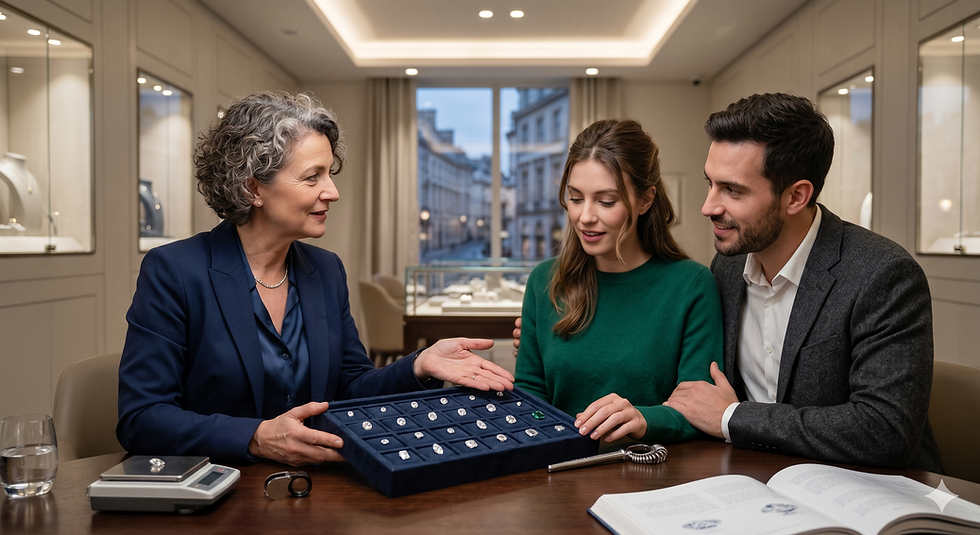
Step 4 — See it in person No photograph, no screen, and no description fully captures how a diamond shape looks on a specific hand in real light.
The Nishal Gems Promise on Every 2 Carat Lab-Grown Stone
Every 2 carat lab-grown diamond at Nishal Gems is:
IGI certified — independently graded for cut, colour, clarity, and carat weight by one of the world's most respected gemological laboratories.
Presented with full transparency — we explain every grade, every characteristic, and every price point before you make any decision.
Available in every shape on this list — we maintain a curated selection across all seven shapes in the 2 carat range, available for in-person comparison in real light.
Frequently Asked Questions
Q1. What is the best shape for a 2 carat lab-grown diamond engagement ring?
There is no single best shape — it depends entirely on the person wearing it. Round brilliant gives maximum sparkle. Oval and pear elongate the finger. Emerald and Asscher offer architectural elegance. Cushion brings warmth and vintage character. Radiant delivers bold brilliance in a rectangular outline.
Q2. Does a 2 carat lab-grown diamond look the same as a 2 carat natural diamond? Yes — completely. A lab-grown diamond is chemically, physically, and optically identical to a natural diamond. The same shape, the same brilliance, the same IGI grading, and the same beauty on the hand. No instrument, no trained eye, and no photograph can tell them apart.
Q3. Which shape makes a 2 carat diamond look the largest on the hand?
Oval, pear, and emerald cuts appear the largest face-up because their elongated outlines cover more surface area on the finger than a round brilliant of the same carat weight. If maximum visual size is the priority, oval is the most popular choice at Nishal Gems for exactly this reason.
Q4. What cut grade should I insist on for a 2 carat lab-grown diamond?
Always prioritise Excellent or Very Good cut grade — regardless of shape. Cut is the single most important factor in how beautiful a diamond looks. At 2 carats, a poorly cut stone is immediately noticeable. At Nishal Gems, every stone we present meets a minimum Very Good cut grade, and we always recommend Excellent where your budget allows.
Q5. What clarity grade do I need for a 2 carat lab-grown diamond?
For brilliant cut shapes — round, oval, cushion, pear, radiant — VVS2 or SI1 is the sweet spot. Both are eye-clean and offer exceptional value. For step cut shapes — emerald and Asscher — we recommend VVS2 or higher, as their large open tables make inclusions more visible to the naked eye.
Q6. What colour grade should I choose for a 2 carat lab-grown engagement ring?
G or H colour is the sweet spot for most settings. The difference between D and G is nearly invisible to the naked eye in a set ring, but the price difference is significant. For yellow gold settings, J or K colour works beautifully — the warm tone of the metal masks any faint tint completely.
Q7. Is an IGI certificate enough for a lab-grown diamond, or do I need GIA?
IGI is the leading and most trusted grading authority for lab-grown diamonds globally — fully independent, internationally recognised, and the certificate of choice for lab-grown stones. Every lab-grown diamond at Nishal Gems carries an IGI certificate. You can verify every certificate number directly on the IGI website.
Q8. Which 2 carat shape is best for someone with shorter fingers?
Oval, pear, and emerald cuts are the most flattering for shorter fingers — their elongated outlines create a visual effect of length and slenderness. Avoid very wide or perfectly square shapes if finger elongation is a priority.
Q9. Which shape is the most durable for everyday wear at 2 carats?
Round brilliant, cushion, and radiant cuts are the most durable for daily wear — they have no sharp points or delicate corners that are vulnerable to chipping. Pear and marquise shapes have a pointed tip that requires a protective V-prong setting. Emerald and Asscher cuts have cropped corners that are naturally more protected than princess cuts.

Interested in sourcing CVD lab-grown diamonds? contact our team to discuss your requirements.
Related reading:
Comments