
How to Identify Quality in Lab-Grown Diamonds
- nishalgems
- 4 days ago
- 7 min read
A retailer emailed us last month with a photo of two round lab-grown diamonds, both a full carat, both "VS clarity" according to the invoice from a different supplier. One looked alive under the loupe. The other looked flat, almost sleepy, even though the paperwork said they should perform the same. That email is the whole reason this article exists.
.
Here's the thing — a lot of buyers assume that once a diamond is lab-grown, quality becomes a non-issue. It doesn't. Lab-grown diamonds have the exact same crystal structure as mined diamonds, but the growing process, the cutting decisions, and the finishing work still vary enormously from one producer to the next. Two stones can carry the same carat weight and clarity grade on paper and still look completely different in a ring.
So let's actually go through what separates a genuinely high-quality lab-grown diamond from one that just has decent paperwork.
Why This Topic Matters
At Nishal Gems, we grow and cut lab-grown diamonds every single day, and we still see enormous quality spread across the industry. Some of that comes down to the growth method — CVD versus HPHT — and some of it comes down to decisions made purely at the cutting wheel. A cutter under pressure to preserve carat weight will often sacrifice light performance. That decision doesn't show up anywhere on a certificate. It only shows up when the stone is in your hand.
Retailers who don't know what to check end up either overpaying for an average stone or, worse, stocking something that disappoints a customer at the counter.
Key Definitions
Growth method refers to how the diamond was created — Chemical Vapor Deposition (CVD) builds the crystal layer by layer in a gas chamber, while High Pressure High Temperature (HPHT) recreates the conditions deep in the earth using intense pressure and heat. Both produce real diamond. Neither method alone tells you quality.
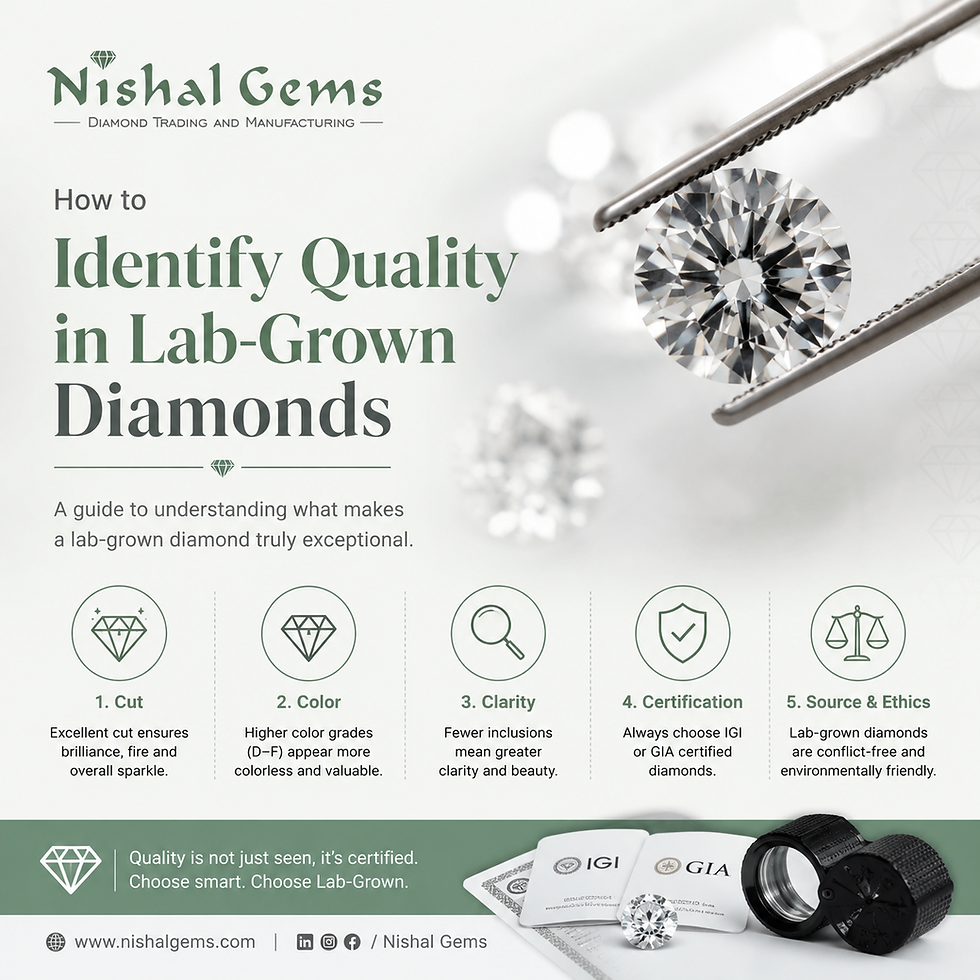
Cut grade measures how well the stone's proportions, symmetry, and polish let light enter, bounce around, and return to your eye as brilliance and fire.
Clarity describes internal and external characteristics, called inclusions and blemishes, visible under 10x magnification.
Color grade measures how close to colorless a stone is, graded on the standard D-to-Z scale used across the industry.
The 4Cs, As They Actually Apply to Lab-Grown Stones
Cut
Cut is where we'd tell you to spend the most attention, and it's the one factor most buyers skip past. An Excellent or Ideal cut grade on a round brilliant means the proportions are optimized for light return. Step-cut shapes like emerald or asscher work differently — they show flash rather than sparkle, so grading focuses more on symmetry and window clarity than brilliance.
A shallow or overly deep cut can make a stone look glassy or dark in the center, no matter how clean the clarity grade is. Frankly, this is where a lot of budget lab-grown stones cut corners, and it's the easiest place for an untrained eye to miss the problem.
Clarity
Lab-grown diamonds can and do have inclusions. The growth process sometimes leaves behind small metallic inclusions (from the seed or growth chamber) or graining. Most commercial lab-grown stones fall between VVS and SI clarity, and honestly, VS1 to VS2 is where the sweet spot sits for most retail buyers — eye-clean, but priced sensibly.
We get this question constantly: "Is SI clarity bad?" Not necessarily. An eye-clean SI stone can look identical to a VVS stone to the naked eye. What matters is whether the inclusions are positioned where they affect brilliance or durability, not just their grade on paper.
Color
D-to-F is colorless, G-to-J is near-colorless and where most commercial buyers land, and anything K and below starts to show a faint warmth, especially in larger carat weights. For engagement ring centers, we typically recommend G-H as the point where quality and value meet. Whiter isn't always better if the setting is yellow or rose gold — warmer color grades can actually look more intentional in those settings.
Carat
Carat weight is simply the diamond's mass, and it's the C most buyers fixate on first. But a heavier stone with a poor cut will look smaller and duller than a slightly lighter, well-cut stone. We've seen this trip up first-time wholesale buyers who order strictly by carat weight without asking about proportions.
Certification: The Non-Negotiable Check
No matter how good a stone looks, we tell every buyer the same thing — never buy a lab-grown diamond above melee size without a certificate from a recognized lab. IGI, GIA, and GCAL are the three names that matter most in this industry right now, and each has slightly different grading tendencies.
GIA is generally regarded as the strictest and most conservative grader. IGI has become the dominant lab for lab-grown certification volume and is well-recognized globally, though its grading can run a touch more generous than GIA on borderline stones. GCAL is known for detailed light performance reporting alongside the standard grading.
If you're comparing two "VS1" stones from different labs, don't assume they're identical.
Ask which lab issued each report before comparing price per carat.
Comparison Table: Clarity Grades at a Glance
Grade | What You'll See | Best For |
FL/IF | No inclusions visible at 10x | Investment-grade pieces, rarely needed for retail |
VVS1/VVS2 | Extremely minor inclusions, hard to find even for a trained grader | Premium retail lines |
VS1/VS2 | Minor inclusions, typically eye-clean | Most engagement rings, best value |
SI1/SI2 | Noticeable under magnification, often still eye-clean | Budget-conscious buyers, still solid quality |
I1+ | Visible to the naked eye | Avoid for center stones |
Step-by-Step: How to Check a Stone's Quality Yourself
Ask for the certificate first, before you even look at the stone. Confirm the lab name, report number, and that the measurements match the physical stone.
Check the cut grade — for round brilliants, look for Excellent or Very Good. For fancy shapes, ask about the length-to-width ratio and symmetry notes.
View the stone under 10x magnification if possible, or ask for a plotted diagram showing where inclusions sit.
Compare color under neutral lighting — daylight-balanced LED, not warm indoor bulbs, which can make lower grades look better than they are.
Ask about fluorescence. Strong blue fluorescence can occasionally make a lower color grade appear whiter, though in rare cases it can also cause a slightly hazy look in larger stones.
Request the inscription number on the girdle and verify it matches the certificate under a jeweler's loupe.
Common Mistakes Buyers and Retailers Make
Now, some people will say certification alone is enough to guarantee quality, and they're not entirely wrong — a certificate does confirm authenticity and basic grading. But it doesn't tell you how the stone will actually look set in a ring. We've seen retailers order purely off a spec sheet and get stones that technically match the grades but underwhelm visually because of cut quality that isn't fully captured in a summary grade.
Another common mistake: assuming a lower price automatically means a lower-quality producer. Pricing varies with growth capacity, cutting efficiency, and scale, not only quality. And on the flip side, a higher price doesn't automatically mean better quality either — always verify against the actual grading, not the sticker price.
Manufacturer Perspective
We had a retailer in the UK last year who was sourcing melee stones in bulk and kept getting inconsistent batches from a previous supplier — same paperwork, visibly different sparkle from parcel to parcel. Once we walked them through checking cut proportions batch by batch rather than trusting a blanket clarity grade, their return rate from end customers dropped noticeably within two shipments.
To be honest, there's no single right answer on which clarity or color grade is "best" — it depends entirely on the piece, the setting, and the customer's budget. Our job as a manufacturer is to be transparent about exactly what's in a parcel before it ships, not just hand over a grade and hope it holds up under a loupe.
Wholesale Buyer Insights
If you're sourcing diamonds for the first time at scale, ask any manufacturer for parcel photos or video under magnification before committing to a bulk order, not just a spec sheet. Consistency across a parcel matters as much as the grade of any single stone.
Retail Buyer Insights
Whether you're a retailer stocking rings or an individual buyer choosing a center stone, prioritize cut quality and eye-clean clarity over chasing the highest possible color grade. A well-cut G color stone will almost always outperform a poorly cut D color stone in actual sparkle.
Industry Trends
IGI certification volume for lab-grown diamonds has grown substantially over the past few years as more manufacturers scale CVD production, and retailers increasingly request video-graded reports alongside static certificates for added buyer confidence.
Expert Recommendations
Prioritize cut grade first, clarity second, color third, and carat last when quality is the deciding factor over size. Always match the certificate to the physical stone before finalizing a purchase.
FAQ
Do lab-grown diamonds have the same quality grades as natural diamonds?
Yes. They're graded on the same 4Cs — cut, color, clarity, carat — using the same scales as natural diamonds.
What is the most important factor for lab-grown diamond quality?
Cut grade, since it determines how much brilliance and fire the stone actually shows once set.
Can lab-grown diamonds have inclusions?
Yes, most fall between VVS and SI clarity, with small inclusions from the growth process itself.
What certification should I look for?
IGI, GIA, or GCAL are the three most trusted labs for lab-grown diamond reports right now.
Is IGI or GIA better for lab-grown diamonds?
GIA tends to grade more conservatively, while IGI is the current volume leader for lab-grown certification globally.
What clarity grade is best value?
VS1 or VS2, since they're typically eye-clean without the premium pricing of VVS or flawless grades.
What color grade should I choose?
G-H color offers the best balance of near-colorless appearance and value for most buyers.
Does carat weight indicate quality?
No, A well-cut smaller stone often looks better than a larger, poorly cut one.
What does "eye clean" mean?
It means no inclusions are visible to the naked eye without magnification, even if some show up under a loupe.
Does fluorescence affect quality?
It can slightly affect appearance in certain lighting, but it doesn't affect durability or authenticity.
How can I verify a certificate is genuine?
Check the report number against the issuing lab's website and confirm it matches the stone's inscription.
Do all lab-grown diamonds look the same?
No, quality varies by growth method, cutting decisions, and finishing, just like natural diamonds.
What is a diamond inscription?
A microscopic laser engraving on the girdle showing the report number, used to match a stone to its certificate.
Should I buy a lab-grown diamond without a certificate?
We wouldn't recommend it for anything above melee size — certification is your main proof of grading and authenticity.
What should a wholesale buyer ask a manufacturer before ordering?
Request parcel-level photos or video under magnification, confirm the certifying lab, and ask about consistency across the batch.


Comments