
Where to Buy High-Quality Lab-Grown Diamonds in Surat: The Definitive 2026 Sourcing Guide for Retailers and Wholesalers

Why Surat Is the World's Lab-Grown Diamond Sourcing Capital
If you are a jewelry retailer, wholesale diamond buyer, or international diamond importer looking for a reliable, high-volume supply of certified lab-grown diamonds — Surat is not just an option. It is the destination.
Surat, Gujarat processes an estimated 90% of the world's rough diamonds and has, over the last decade, made an equally decisive pivot into lab-grown diamond manufacturing. Today, the city is home to hundreds of CVD and HPHT diamond growth facilities, precision cutting and polishing units, and fully integrated diamond export houses — making it the most competitive lab-grown diamond sourcing hub on the planet.
For B2B buyers, this concentration of manufacturing capability translates directly into one thing: superior quality at a price point no other geography can match. But navigating Surat's diamond trade — knowing which manufacturers are reliable, which certifications actually matter, and how to avoid common sourcing pitfalls — requires more than just a Google search.
This guide is written for diamond industry professionals. It covers everything you need to make a confident, informed sourcing decision in 2026: from understanding the manufacturing landscape, to evaluating IGI grading reports, to building long-term supplier relationships that protect your margins.
The Surat Lab-Grown Diamond Ecosystem: What Buyers Need to Know First
How Surat Built a Vertically Integrated Lab-Grown Diamond Industry
Surat's dominance in the diamond trade did not happen overnight. Decades of accumulated expertise in diamond cutting, polishing, and grading — combined with Gujarat's strong manufacturing infrastructure and access to skilled artisans — created the conditions for lab-grown diamond production to scale rapidly.
Unlike natural diamond supply chains that span multiple continents (mine → rough trader → cutter → polisher → certification → dealer), Surat-based manufacturers frequently manage the entire value chain in-house. A single manufacturer in Surat's GIDC industrial belt or the Varachha Road corridor may operate CVD reactors, an in-house polishing unit, a quality inspection lab, and a direct export desk — all under one roof.
For B2B buyers, this vertical integration offers three concrete advantages: faster turnaround on custom orders, tighter quality control at each production stage, and more transparent pricing since margin stacking across intermediaries is minimized.
The Scale of Lab-Grown Diamond Production in Surat (2026)
The lab-grown diamond segment has grown from a niche category to a primary business line for hundreds of Surat manufacturers. India now accounts for over 15% of global lab-grown diamond production by volume, and Surat contributes the majority of that output. Leading Indian export bodies and the Gem and Jewellery Export Promotion Council (GJEPC) have tracked consistent year-on-year growth in lab-grown diamond exports from Gujarat, with key destination markets including the United States, the European Union, the UAE, and Australia.
For international buyers in particular, India's lab-grown diamond cost structure — driven by lower energy costs, skilled labor, and scaled manufacturing — continues to offer margin advantages that are structurally difficult to replicate in Western manufacturing markets.

Understanding Lab-Grown Diamond Manufacturing: CVD vs HPHT
Before evaluating any Surat supplier, buyers need a firm grasp of the two primary production technologies — because the choice between them affects everything from the diamond's optical characteristics to its price, gradeability, and suitability for your end market.
CVD (Chemical Vapor Deposition) — The Preferred Method for Premium Quality
CVD diamonds are grown inside a reactor chamber where carbon-rich gases (typically methane and hydrogen) are ionized into plasma at extreme temperatures. Carbon atoms slowly deposit onto a thin diamond seed plate, building the crystal layer by layer over several weeks.
CVD produces diamonds with excellent chemical purity, lower strain levels, and superior color potential — making it the dominant method for producing Type IIa diamonds, the same classification as some of the rarest and most valuable natural diamonds in the world. The controlled growth environment in CVD also makes it easier to produce consistent, repeatable quality — a critical factor for B2B buyers sourcing at volume.
HPHT (High Pressure High Temperature) — Established, Reliable, and Cost-Competitive
HPHT mimics the geological conditions under which natural diamonds form — applying enormous pressure (around 1.5 million PSI) and temperatures exceeding 1,400°C to a carbon source and a metal catalyst. The process is faster than CVD and well-suited to producing diamonds in the lower color and clarity ranges efficiently.
HPHT is also used as a post-growth treatment on CVD diamonds to improve color, which is industry-standard practice and fully disclosed on IGI and GIA grading reports.
CVD vs HPHT: Quick Comparison for Buyers
Feature | CVD | HPHT |
Growth Speed | Slower (weeks) | Faster (days) |
Color Range | D–J (excellent potential) | D–J (wider variation) |
Clarity Potential | VS2–IF achievable | VS2–IF achievable |
Diamond Type | Often Type IIa | Often Type Ib |
Post-Treatment | Sometimes HPHT-treated for color | No post-treatment |
Price Point | Slightly higher for equivalent grade | More competitive at lower grades |
Best For | Premium retail, high-color demand | value-optimized sourcing, melee |
Detectability | Detectable with advanced equipment | Detectable with advanced equipment |
Both technologies produce chemically and physically identical diamonds to natural stones. Neither is inherently superior — the right choice depends on your target price point, required grade range, and end-customer expectations.
For more details refer the article of CVD vs HPHT

IGI Certification: The Non-Negotiable Standard for Lab-Grown Diamond Trade
Why IGI Has Become the Default for Lab-Grown Diamonds
The International Gemological Institute (IGI) has established itself as the industry benchmark for lab-grown diamond grading reports. Among professional B2B buyers, IGI certification is frequently a purchasing prerequisite — and for good reason.
IGI's grading methodology for lab-grown diamonds mirrors the 4Cs framework (Cut, Color, Clarity, Carat) that the market is built on. An IGI report provides the buyer with documented, independent assurance of a diamond's grade, its growth method (CVD or HPHT), and whether any post-growth treatments have been applied. This documentation is not a formality — it is the foundation of trust in every transaction.
For retailers in regulated markets (EU, US, UK, Australia), IGI certification also provides legal protection. Consumer protection standards in these jurisdictions require accurate disclosure of material product characteristics — and an IGI grading report is the most defensible form of that disclosure.
What an IGI Lab-Grown Diamond Report Covers
A standard IGI lab-grown diamond grading report includes:
Shape and cutting style — e.g., Round Brilliant, Oval, Cushion
Measurements — to the nearest 0.01mm
Carat weight — to the nearest 0.01ct
Color grade — D through Z scale
Clarity grade — FL through I2 scale
Cut grade — Excellent, Very Good, Good, Fair, Poor
Polish and Symmetry grades
Fluorescence — None, Faint, Medium, Strong, Very Strong
Growth method — CVD or HPHT
Treatment disclosure — Post-growth treatment (if any)
Unique laser inscription number — matching the report
GIA vs IGI for Lab-Grown Diamonds: Practical Considerations
GIA (Gemological Institute of America) also certifies lab-grown diamonds. In some premium retail segments and high-net-worth markets, GIA branding carries additional prestige. However, for wholesale and B2B trade — particularly in the mid-market — IGI is the more operationally practical standard, with faster turnaround and broader acceptance across trade networks in Asia, the Middle East, and Europe.
Aspect | IGI | GIA |
Industry Recognition | Very High (B2B dominant) | Very High (retail premium) |
Turnaround Time | Faster | Slower |
Cost of Certification | Lower | Higher |
Acceptance in Wholesale | Widely accepted globally | Widely accepted globally |
Preferred Segment | Wholesale, mid-to-premium retail | Ultra-premium retail |
Lab-Grown Diamond Volume | Very high | Moderate |
How to Evaluate Lab-Grown Diamond Suppliers in Surat
The Five-Tier Supplier Evaluation Framework
Not every manufacturer in Surat operates at the same standard. For B2B buyers — particularly those sourcing for international markets — a structured evaluation process protects you from quality inconsistencies, certification fraud, and supply disruptions.
Tier 1: Manufacturing Capability Verification
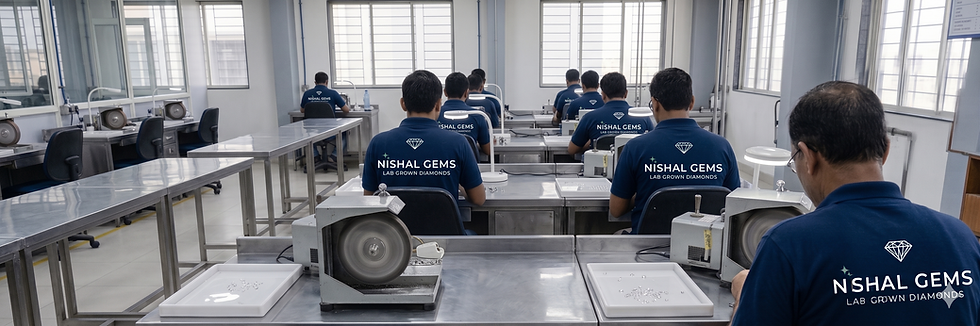
Understand whether the supplier operates their own growth facility (CVD reactors or HPHT presses) or is a trader sourcing from third-party producers. Manufacturers with in-house production have superior quality control and can offer better pricing. Ask for a facility visit or request production documentation.
Tier 2: Certification Authenticity
Every IGI (or GIA) report has a unique number. Verify it directly on the IGI website before completing any purchase. Independent report verification is considered standard best practice in professional diamond sourcing — this verification step is non-negotiable on new supplier relationships.
Tier 3: Export Compliance and Documentation
Surat-based exporters should provide a full documentation package: export invoice, packing list, KP (Kimberley Process) certificate (even for lab-grown diamonds, many jurisdictions require equivalent certification), and GST compliance documentation. Verify that the supplier has an active IEC (Import Export Code) registered with DGFT India.
Tier 4: Consistency Across Batches
A supplier's ability to deliver consistent quality across multiple orders is more important than the quality of any single sample lot.
Tier 5: Communication and Order Management For international buyers managing supply chains remotely, responsiveness and order transparency matter. Evaluate whether the supplier can provide real-time inventory lists in standardized formats (CSV/Excel with exact specifications), timely shipping documentation, and a clear process for handling returns or grade disputes.
Diamond Grading and Quality Standards: What Experienced Buyers Look For
Understanding the 4Cs in a B2B Context
The 4Cs — Cut, Color, Clarity, Carat — are the universal grading language of the diamond industry. For B2B buyers, however, the practical interpretation of these grades is more nuanced than the simplified consumer-facing version.
Cut is the most important grade for a diamond's visual performance and is entirely within the manufacturer's control. For round brilliants, an Excellent cut grade (IGI) indicates optimal light return. For fancy shapes (oval, pear, cushion, emerald), cut quality is assessed through measurements, table percentage, depth percentage, and length-to-width ratios rather than a single grade. Surat's polishing units, particularly at the premium tier, have developed significant expertise in fancy shape cutting — a key differentiator for buyers serving markets with high demand for non-round shapes.
Color directly determines price more than any other factor at the wholesale level. In the lab-grown market, D–F color stones command significant premiums and are in strong demand for premium retail settings. G–H color represents the most liquid segment of the market — strong demand at a more accessible price point. I–J color is suitable for retailers operating in value-oriented segments.
Clarity in lab-grown diamonds follows the same GIA/IGI scale as natural diamonds. For most retail applications, VS2 and above is the practical floor — SI1 is acceptable in smaller carat weights where inclusions are less visible, but VVS and above grades command premiums in the bridal and luxury segments.
Carat weight in the lab-grown segment is more flexible than in natural diamonds because production can be calibrated to target weight ranges. This is a significant procurement advantage — buyers can specify 0.90–0.99ct or 1.00–1.09ct windows, and manufacturers can supply to specification with much greater consistency than natural diamond traders.
Key Quality Metrics Beyond the 4Cs
Experienced buyers evaluate several additional parameters that do not appear in a grading report:
Table percentage — For round brilliants, 53–58% is considered optimal. Deviate significantly outside this range and light performance degrades even with an Excellent cut grade.
Depth percentage — For rounds, 59–62.5% is the ideal window. Diamonds cut too deep or too shallow sacrifice brilliance.
Girdle thickness — Extremely thin or extremely thick girdles affect both durability and visual appearance. Medium to slightly thick is preferred for most applications.
Culet size — None or pointed is standard for modern cuts. A large culet is visible through the table and considered a quality flaw.
Market Trends Shaping Lab-Grown Diamond Sourcing in 2026
The Price Story
Consumer adoption of lab-grown diamonds has grown substantially — particularly in the US, Europe, and Australia — creating sustained demand that has absorbed much of the production capacity increase.
For retailers and wholesalers, this stabilization represents a mature sourcing environment — price discovery is more transparent, certified diamonds are more liquid, and the lab-grown diamond market has evolved into a more transparent and operationally mature sourcing ecosystem, enabling buyers to plan inventory and pricing with greater confidence. The competitive advantage for retailers now lies in product quality, certification credibility, and supply chain reliability rather than raw price speculation.
The Premiumization of Lab-Grown Diamonds
A significant 2026 trend is the upmarket movement in lab-grown diamond positioning. Major US and European jewelry retailers who initially merchandised lab-grown as a "accessible luxury alternative" are increasingly positioning premium, IGI-certified lab-grown diamonds as a distinct category — valued for their ethical credentials, technical perfection, and price accessibility relative to comparable natural diamonds.
This shift creates real demand for top-grade lab-grown product: D–F color, VVS–VS clarity, Excellent cut, with full IGI documentation. Surat manufacturers operating at this quality level are seeing stronger and more consistent demand from international accounts than the mid-market has delivered.
Ethical Sourcing as a Commercial Differentiator
Consumer awareness of supply chain ethics has moved from a niche concern to a mainstream purchasing consideration — particularly for millennial and Gen Z buyers who now represent the dominant diamond-purchasing demographic in the US and Europe.
Lab-grown diamonds have a structurally compelling story here: no mining disruption, no community displacement, a dramatically smaller land and water footprint, and a fully transparent, documented supply chain. For retailers, this narrative is a commercial asset — and for wholesalers sourcing from reputable Surat manufacturers, the provenance documentation that supports this narrative (production facility details, energy use disclosures, manufacturing certifications) is increasingly being requested and expected.

Common Mistakes B2B Buyers Make When Sourcing Lab-Grown Diamonds in Surat
1. Prioritizing Price Over Supplier Qualification
The most expensive mistake a buyer can make is selecting a supplier purely on the basis of the lowest per-carat price. Surat's market has many traders who will quote aggressively and deliver inconsistently — misrepresented grades, certification discrepancies, and fulfillment failures are common when buyers skip the supplier evaluation process.
Established manufacturers with verifiable production history, documented export records, and references from international accounts will quote slightly higher prices — and deliver reliably, consistently, and to specification.
2. Not Verifying Grading Reports Independently
It is not uncommon for buyers — particularly first-time international buyers — to accept grading report photocopies without verifying the report number directly with IGI. This is an avoidable risk. Every IGI report can be verified at igi.org using the unique report number laser-inscribed on the diamond's girdle.
3. Ignoring Fancy Shape Length-to-Width Ratios
For fancy shape diamonds (oval, pear, cushion, emerald), the length-to-width ratio dramatically affects the stone's visual appearance and market desirability. Buyers who do not specify L/W ratios in their purchase orders frequently receive shapes that are too round, too elongated, or outside the market preference windows for their specific customer base. US retailers typically prefer oval diamonds in the 1.35–1.50 L/W range; European buyers often favor slightly longer ratios. Specify this upfront.
4. Underestimating Lead Times for Custom Orders
Surat manufacturers operate at scale, but custom color/clarity/shape combinations may require waiting for specific production runs. Buyers who do not build sourcing lead times into their inventory planning — particularly for high-grade stones — often face stockouts during peak selling periods (Q4, Valentine's Day, Mother's Day windows).
5. Skipping the Post-Growth Treatment Disclosure Conversation
HPHT treatment of CVD diamonds to improve color is industry-standard and fully disclosed in IGI reports. However, buyers should explicitly confirm with their supplier whether stones in their consignment have been post-treated, and whether this is reflected accurately on all grading reports. End-market disclosure requirements vary by jurisdiction, and being caught with undisclosed treated stones creates significant legal and reputational risk for retailers.
Why Nishal Gems: Sourcing from a Trusted Surat Manufacturer
Nishal Gems is a premium lab-grown diamond manufacturer based in Surat, Gujarat, with over three decades of combined experience in the diamond industry. Established in 1992, the company has built its reputation on a straightforward proposition: consistent quality, certified product, and accountable supply.
Every loose lab-grown diamond supplied by Nishal Gems is independently certified (IGI) and fully compliant with international export documentation standards. The company serves jewelry retailers, wholesalers, and diamond importers across the US, Europe, the Middle East, and Asia-Pacific — with a dedicated B2B supply structure designed for scalable, repeatable ordering.
What distinguishes Nishal Gems in a crowded Surat market is not simply price — it is the combination of manufacturing transparency, grading integrity, and the kind of long-term supply relationship that professional buyers actually need to run their businesses.
Whether you are a retailer looking to build a lab-grown diamond program from scratch, a wholesaler seeking a reliable Surat production partner, or an international buyer evaluating Indian manufacturers for the first time — Nishal Gems welcomes the conversation.

FAQ: Buying Lab-Grown Diamonds in Surat — Answers for B2B Buyers
Q-1: What is the minimum order quantity for lab-grown diamonds from Surat manufacturers?
Most reputable Surat manufacturers have flexible MOQs for certified diamonds, typically starting from 5–10 carats for mixed parcels. For single-specification lots (e.g., all 1.00–1.09ct D/VS2 round brilliants), MOQs may be higher depending on production cycle timing. Contact manufacturers directly to understand current availability and minimum order thresholds for your specification.
Q-2: Are all lab-grown diamonds from Surat IGI-certified?
No. Certification depends entirely on the manufacturer and what the buyer requests. Many manufacturers offer independently certified diamonds remain the preferred standard for international B2B trade. For B2B buyers supplying international retail markets, independent IGI (or GIA) certification is strongly recommended and, in many markets, effectively required for consumer disclosure compliance.
Q-3: How do CVD lab-grown diamonds compare to HPHT in terms of resale value?
Both CVD and HPHT lab-grown diamonds trade on their certified grade (4Cs) rather than their growth method in the wholesale market. A D/VVS1 CVD and a D/VVS1 HPHT stone of the same carat weight will trade at similar prices in the B2B market. The growth method is disclosed on the IGI report but does not create a systematic price differential between equivalent grades in professional trade.
Q-4: How can I verify that a Surat manufacturer is a legitimate exporter?
Verify the manufacturer's IEC (Import Export Code) through the DGFT India portal. Check their GST registration status. Request references from existing international clients. For manufacturers claiming GJEPC membership, verify membership directly with GJEPC. A site visit or video facility tour is the most reliable verification method for significant new supplier relationships.
Q-5: What shapes and sizes are most readily available from Surat lab-grown diamond manufacturers?
Round brilliant in the 0.30ct–3.00ct range is the highest-availability shape across Surat manufacturers. Oval, cushion, pear, emerald, and princess cuts are widely produced but may require slightly longer lead times for specific grade and size combinations. Fancy shapes above 3.00ct at premium grades (D–F, VS2 and above) are typically made-to-order.
Q-6: What are the typical export documentation requirements for buying diamonds from India?
Typical export documentation from Indian diamond exporters includes a commercial invoice, packing list, KP (Kimberley Process) certificate or equivalent lab-grown disclosure, airway bill (AWB) for air shipments, and GST refund documentation where applicable. For imports into the US, Customs Form 3461 is generally required. At Nishal Gems, we manage the complete export and delivery process, ensuring smooth documentation handling and hassle-free shipment until final delivery.
Q-7: Is it possible to source sustainably produced lab-grown diamonds from Surat?
Yes. An increasing number of Surat manufacturers — including those using renewable energy sources for CVD reactor operations — can provide sustainability documentation including energy use disclosures and facility certifications. Buyers targeting ESG-sensitive retail markets should specifically ask for this documentation during the sourcing conversation.
Q-8: How do lab-grown diamond prices in Surat compare to US or European wholesale prices?
Surat-based manufacturers offer structural cost advantages of 20–40% on a like-for-like certified grade basis compared to US or European diamond wholesalers, primarily due to lower manufacturing and labor costs. Surat continues to maintain a strong manufacturing advantage through production scale, technical expertise, and supply-chain efficiency but Surat remains the most cost-competitive sourcing geography for certified lab-grown diamonds at scale.
Conclusion: Making the Right Sourcing Decision in 2026
Surat's lab-grown diamond industry has matured into a globally competitive, technically sophisticated manufacturing ecosystem. For B2B buyers — whether you are building your first lab-grown diamond inventory program or scaling an existing supply chain — the city offers an unmatched combination of production capability, certification access, and price competitiveness.
The differentiator, in 2026, is not simply finding a supplier in Surat. It is finding the right supplier — one with documented manufacturing standards, consistent certification integrity, and the operational reliability to support your business across multiple seasons and product cycles.
Nishal Gems has been part of the Surat diamond industry since 1992. We understand what professional buyers need: accurate grading, transparent pricing, and a supply relationship built on accountability.
Interested in sourcing CVD lab-grown diamonds? contact our team to discuss your requirements.


Comments