
What Are the Benefits of Lab-Grown Diamonds Over Natural Diamonds?
The Question Every Serious Diamond Buyer Is Asking in 2026
Not long ago, the phrase 'lab-grown diamond' drew skepticism from trade professionals. Today, it draws purchase orders from New York, Dubai, Antwerp, and Tokyo. The transformation of this sector from niche curiosity to mainstream gem trade reality is one of the most consequential shifts in jewelry industry history — and the buyers and retailers who understand it earliest are the ones gaining the most competitive ground.
This is not a lifestyle article about engagement rings. This is an industry-level briefing for professionals: jewelers, wholesalers, importers, and B2B diamond buyers who need to make sourcing decisions backed by facts, data, and verified quality standards. The goal here is simple — to give you the clearest, most actionable comparison of lab-grown diamonds versus natural diamonds from a trade, supply chain, and certification standpoint.
Nishal Gems operates from Surat, India — the world's diamond cutting and polishing capital — and has built a reputation as a trusted manufacturer and supplier of premium loose lab-grown diamonds for international B2B markets. What follows reflects not just industry knowledge, but direct operational experience from the heart of global diamond manufacturing.
Lab-grown diamonds offer jewelers and buyers significant advantages over natural diamonds in five key areas: physical and chemical identity (they are real diamonds, not simulants), ethical sourcing integrity, supply chain transparency, manufacturing precision and consistency, and environmental footprint. Certified by IGI and GIA, lab-grown diamonds produced via CVD or HPHT processes meet the same grading standards as mined stones — while offering B2B buyers traceable origin, scalable supply, and verified quality control.
1. They Are Diamonds — Chemically, Physically, and Optically
The single most important fact that every retailer must communicate — and every wholesaler must understand — is this: a lab-grown diamond is not a diamond simulant. It is not cubic zirconia. It is not moissanite. It is a real diamond.
According to the Federal Trade Commission (FTC) and the International Gemological Institute (IGI), lab-grown diamonds share the exact same chemical composition (pure carbon, crystallized in a cubic structure), the same crystal lattice, the same refractive index, the same hardness rating of 10 on the Mohs scale, and the same optical properties as any diamond extracted from the earth.
This distinction matters enormously in a B2B context. Retailers who stock certified lab-grown diamonds are not offering a compromise product — they are offering an identical gem with a different origin story. When your customer asks 'is this a real diamond?', the answer, scientifically and legally, is yes.
What Makes a Diamond a Diamond
Property | Lab-Grown Diamond | Natural Diamond |
Chemical Composition | Pure Carbon (C) | Pure Carbon (C) |
Crystal Structure | Cubic (Isometric) | Cubic (Isometric) |
Hardness (Mohs) | 10 | 10 |
Refractive Index | 2.417 – 2.419 | 2.417 – 2.419 |
Thermal Conductivity | Identical | Identical |
Dispersion | 0.044 | 0.044 |
IGI/GIA Certifiable | Yes | Yes |
Detectable Difference | Only by specialist equipment | Baseline |
The only way to distinguish a lab-grown diamond from a mined diamond is through advanced spectroscopic analysis — not visible to the naked eye, not detectable by standard gemological loupe, and not apparent to any customer in a retail setting. This is not marketing language. This is materials science.
2. Ethical Sourcing: The Trade Advantage That Is Only Growing
The diamond industry has carried the burden of its sourcing history for decades. Conflict diamonds — also known as blood diamonds — remain a reputational risk for any business that cannot clearly document its supply chain. The Kimberley Process was a step forward, but the global B2B community, particularly buyers in Europe, North America, and progressive Asian markets, has continued to demand higher transparency standards.
Lab-grown diamonds, by definition, resolve the conflict origin problem entirely. They are manufactured in controlled facilities — not excavated from conflict zones. There are no child labor concerns, no environmental displacement of communities, no murky middlemen in fragile geopolitical regions. For any retailer building a brand narrative around ethical luxury, lab-grown diamonds are not just an option — they are the most defensible sourcing choice available.
Industry Intelligence
A 2024 Edelman Trust Barometer survey found that over 67% of luxury goods buyers under 40 consider supply chain ethics a primary factor in purchasing decisions. For B2B buyers sourcing diamonds for these retail markets, offering IGI-certified lab-grown diamonds is increasingly a commercial necessity, not a differentiator.
What Ethical Sourcing Means for Your B2B Supply Chain
• Zero conflict-origin exposure: lab-grown diamonds carry no geopolitical provenance risk.
• Full traceability: reputable manufacturers like Nishal Gems provide documented production origin for every stone.
• Compliant with international trade ethics frameworks: no Kimberley Process complications for cross-border transactions.
• Brand alignment with ESG (Environmental, Social, Governance) standards that international retailers increasingly require from suppliers.
• Reduced due diligence burden: buyers do not need to verify origin across multiple intermediary handlers.
3. Manufacturing Precision: CVD and HPHT — What B2B Buyers Need to Know
Two primary technologies produce lab-grown diamonds at commercial scale: Chemical Vapour Deposition (CVD) and High-Pressure High-Temperature (HPHT). Understanding both is essential for any professional buyer, because the production method affects the stone's characteristics, available sizes, and applicable use cases.
CVD vs HPHT: The Technical Breakdown
Factor | CVD (Chemical Vapour Deposition) | HPHT (High-Pressure High-Temperature) |
Process | Carbon-rich gas deposited layer by layer on a seed crystal in a vacuum chamber | Simulates underground conditions — extreme pressure (5–6 GPa) and heat (1,300°C+) |
Crystal Growth | Slow and controlled — typically 2–4 weeks per stone | Faster growth cycle, typically days to 2 weeks |
Available Shapes | Predominantly square/rectangular rough, suitable for most standard cuts | Octahedral rough, ideal for round brilliants |
Colour Range | D–J common; Type IIa stones achievable at scale | D–J; yellows and fancy colours more frequent |
Clarity Range | VS1–VS2 common; IF achievable with post-growth treatment | VVS1–VS1 common at scale |
Ideal Use Cases | High-value colourless stones, precision cutting, melee diamonds | Round brilliants, fancy coloured diamonds |
Post-Growth Treatment | Some stones undergo annealing to remove strain colour | Less common; some clarity enhancement used |
IGI Grading | Fully graded — method disclosed on certificate | Fully graded — method disclosed on certificate |
Both CVD and HPHT diamonds receive full IGI grading reports that disclose the production method. This transparency is not a drawback — it is a feature of a mature, regulated market. Nishal Gems manufactures both CVD and HPHT diamonds to export quality standards, providing B2B buyers with consistent specifications and documented grading for every order.

4. IGI Certification and Diamond Grading: Why It Defines Your B2B Buying Standard
In the wholesale diamond trade, a stone without a credible grading report is a stone without a verifiable identity. IGI — the International Gemological Institute — is the world's leading certification body for lab-grown diamonds, and for good reason. Their grading reports for lab-grown stones are just as rigorous, just as detailed, and just as commercially accepted as those issued for natural diamonds.
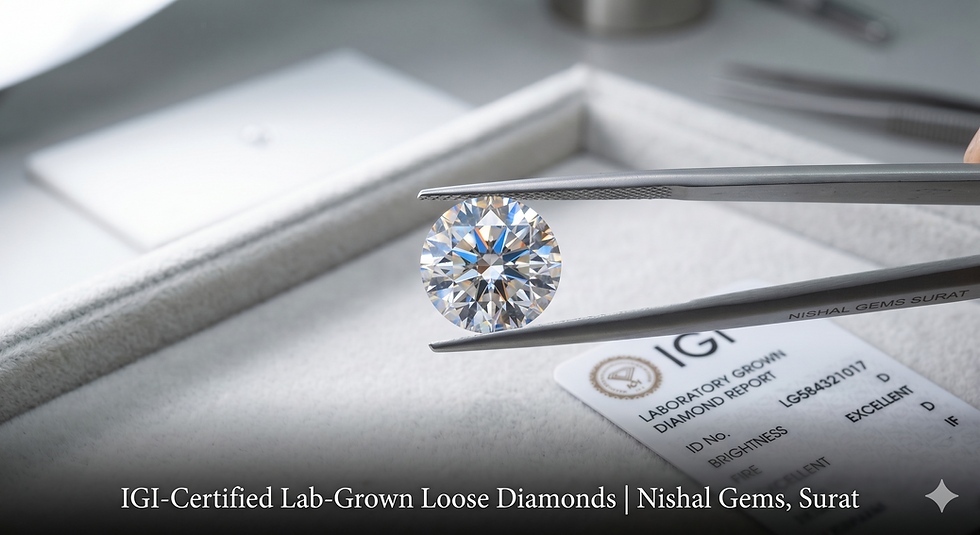
Every Nishal Gems loose lab-grown diamond supplied to B2B buyers is IGI-certified. This is not optional. It is a baseline quality assurance standard that protects both the supplier and the buyer in every commercial transaction.
What an IGI Lab-Grown Diamond Certificate Includes
• 4Cs grading: Cut, Colour, Clarity, Carat Weight — assessed using the same standards applied to natural diamonds.
• Production method disclosure: CVD or HPHT, clearly stated.
• Shape and cutting style identification.
• Measurements (in millimetres) to three decimal places.
• Polish and symmetry grade.
• Fluorescence grade.
• Unique report number with online verification available.
• Laser inscription on the girdle corresponding to the report number.
Buyer Intelligence: IGI vs GIA for Lab-Grown Diamonds While GIA also certifies lab-grown diamonds, IGI has established itself as the dominant grading authority in the lab-grown segment, with faster turnaround times, wider global acceptance in B2B trade channels, and grading reports that are specifically formatted for lab-grown stones. For wholesale buyers and retailers sourcing at scale, IGI-certified lab-grown diamonds represent the current industry standard. Always request an IGI report for any loose lab-grown diamond purchase above 0.30 carats. |
5. Supply Chain Transparency: A Structural Advantage
One of the most underappreciated advantages of sourcing lab-grown diamonds for your retail or wholesale business is the radical simplification of the supply chain. The natural diamond pipeline is notoriously complex — mine to rough trader to cutter to polisher to broker to wholesaler to retailer, with multiple origin handoffs, documentation gaps, and verification challenges at each stage.
The lab-grown diamond supply chain, particularly when sourcing directly from a manufacturer like Nishal Gems, compresses this dramatically. The manufacturer is the origin. Every stone is produced, cut, polished, and certified within a documented, auditable facility. This means the buyer gets a cleaner commercial transaction, fewer intermediary costs, and a traceable product from day one.
Supply Chain Comparison: Lab-Grown vs Natural Diamond
Stage | Natural Diamond Supply Chain | Lab-Grown Diamond Supply Chain (Direct Manufacturer) |
Stage 1 | Mining (multiple countries, varying standards) | Manufacturing facility — documented, controlled |
Stage 2 | Rough sorting and rough trading | Internal quality grading and rough selection |
Stage 3 | Rough cutting centres (often Surat, Antwerp) | Cutting and polishing — same facility or direct partner |
Stage 4 | Polished diamond broker/wholesale | Manufacturer to B2B buyer — direct |
Stage 5 | Wholesale to retailer | IGI certification and export documentation |
Stage 6 | Retailer to customer | Retailer to customer |
Traceability | Challenging; Kimberley Process covers some stages | Full origin documentation from production facility |
Intermediaries | Typically 3–5 commercial layers | 0–2 layers when buying from direct manufacturer |
For international buyers — particularly those importing from India — sourcing directly from a Surat-based lab-grown diamond manufacturer eliminates the opacity that has historically complicated the natural diamond supply chain. Surat accounts for approximately 90% of the world's diamond cutting and polishing volume. When your manufacturer is also your cutter, the chain becomes shorter, more transparent, and more commercially efficient.

6. Environmental Footprint: What the Data Actually Shows
Environmental claims in the diamond industry require careful handling. Oversimplification on either side does a disservice to the professionals making sourcing decisions. What the peer-reviewed research and industry lifecycle analyses consistently show is that lab-grown diamond production, particularly in facilities using renewable energy sources, carries a significantly lower environmental impact than open-pit or underground diamond mining.
Large-scale mining operations disturb thousands of hectares of land, consume enormous volumes of water, and generate significant CO₂ emissions through mechanised excavation and heavy equipment. A 2022 Trucost environmental analysis commissioned by Diamond Foundry estimated that mined diamonds generate approximately 57 kilograms of CO₂ per carat, versus roughly 0.028 grams per carat for lab-grown diamonds produced with renewable energy.
We present this data not as a marketing argument, but as a commercially relevant fact: an increasing number of luxury retailers — particularly in the EU, UK, and sustainability-conscious North American markets — require ESG documentation from their suppliers. Manufacturers who can provide environmental impact data for their production processes have a clear advantage in those tender and procurement conversations.
Environmental Considerations for B2B Buyers
• Verify your manufacturer's energy source: renewable energy production dramatically reduces carbon footprint per carat.
• Request environmental certifications or facility audits if ESG compliance is a requirement from your retail clients.
• Understand that water usage in CVD and HPHT manufacturing is a fraction of the volume required in open-pit mining operations.
• Land disruption: lab-grown diamond production requires a facility footprint, not excavation of virgin ecosystems.
7. Consistency, Scalability, and Specification Control — The B2B Operational Advantage
Perhaps the most undervalued benefit of lab-grown diamonds from a pure business operations standpoint is the ability to order to specification. In the natural diamond trade, a buyer places an order for, say, 100 round brilliant D/VS1/Excellent stones in the 1.00–1.10 carat range and then negotiates against available inventory — accepting variation, making compromises, and managing inconsistency across lots.
In lab-grown diamond procurement, particularly with a direct manufacturer, specification ordering is a realistic commercial expectation. Production can be calibrated. Quality control systems operate within a controlled environment. When Nishal Gems receives a B2B specification order, the production and grading process is oriented toward fulfilling that specification — not sourcing against what happened to emerge from the ground in a given mining season.
What Specification Control Means for Retailers and Wholesalers
• Consistent melee parcels: matching colour, clarity, and cut grade across large melee diamond lots for pave, channel, and halo settings.
• Reliable restocking: retail programmes built on specific stone parameters can be replenished without specification drift.
• Custom cutting: manufacturers with integrated cutting facilities (as in Surat) can produce specific cutting styles and proportions on request.
• Volume scalability: growing retail programmes are not constrained by natural mining yields or rough availability.
• Reduced rejection rates: tighter quality control in manufacturing environments translates to lower lot rejection rates for the wholesale buyer.

8. Retailer Profit Margins: The Commercial Reality
This section addresses a topic that B2B buyers need to understand clearly, without the euphemisms often applied in trade press. The profit margin structure for retailers selling lab-grown diamonds depends on positioning, certification quality, and marketing — not on treating lab-grown diamonds as a discounted category.
Retailers who have successfully built lab-grown diamond businesses have done so by emphasising the quality story — the IGI certification, the ethical origin, the optical identity with mined diamonds — rather than competing purely on accessibility. This positioning preserves margin, builds repeat customers, and creates a sustainable retail category rather than a race to the bottom.
Key Margin Considerations for Lab-Grown Diamond Retailers
• Certification is non-negotiable for margin protection: an uncertified stone cannot command certified-stone retail positioning.
• The '4Cs + Ethics + Origin' narrative is your margin defence: educated customers buying on value, not just accessibility.
• Brand differentiation from generic lab-grown diamond products: sourcing from a premium, consistently graded manufacturer is the difference between commodity and quality product.
• B2B buyers sourcing directly from Surat manufacturers with full IGI documentation are best positioned to maintain retailer margin across their lab-grown collections.
9. Global Market Trends: Where Lab-Grown Diamonds Are Heading in 2026
The lab-grown diamond market has moved through several phases since its commercial emergence: early adopter curiosity, trade resistance, mainstream retail acceptance, and now — active B2B procurement at scale. Understanding the trajectory matters for any business making sourcing commitments.
Key Market Developments in 2026
• Lab-grown diamonds now represent a significant and growing share of the bridal and fashion jewellery segment in the US, UK, Australia, and Germany — markets with sophisticated consumer bases and strong retail infrastructure.
• India remains the dominant manufacturing hub, with Surat-based facilities accounting for the vast majority of global CVD and HPHT production at commercial quality levels.
• Middle Eastern markets — particularly UAE and Saudi Arabia — have seen accelerating lab-grown diamond import volumes as luxury retailers in those markets respond to consumer demand from younger, globally-connected buyers.
• The melee diamond segment (stones under 0.30 carats) has seen particularly strong adoption of lab-grown production, as the consistency and volume scalability of lab manufacturing offers clear operational advantages for high-volume jewellery production.
• International grading standardisation is maturing: IGI's dominance in lab-grown grading has created a consistent quality language that simplifies cross-border B2B transactions.

10. Common Mistakes B2B Diamond Buyers Make — And How to Avoid Them
Mistake #1: Buying Uncertified Lab-Grown Diamonds to Reduce Costs
The short-term cost reduction from buying uncertified stones creates long-term commercial risk. Retailers cannot verify specifications, cannot make accurate representations to customers, and cannot build a defensible quality narrative. Always insist on IGI certification for any stone above melee weight.
Mistake #2: Treating CVD and HPHT as Interchangeable Without Understanding the Application
Both are real diamonds, but their production characteristics make them better suited to different cutting styles and use cases. Buyers who order without specifying the production method may receive stones that require treatment or that do not match the intended cut profile. Work with a manufacturer that clarifies this at the order stage.
Mistake #3: Sourcing Through Multiple Intermediary Layers When Direct Manufacturer Access Is Available
Every intermediary layer adds cost and reduces supply chain transparency. Surat-based manufacturers with direct B2B export capabilities — like Nishal Gems — offer buyers a shorter, more transparent, more cost-efficient supply chain than traditional multi-step wholesale channels.
Mistake #4: Failing to Verify the Grading Laboratory's Acceptance in Your Target Market
IGI is globally accepted and market-dominant for lab-grown diamonds. Some buyers from markets with specific retailer requirements may need GIA or other regional certification. Confirm the required certification standard before placing production orders.
Mistake #5: Ordering Lot Parcels Without Detailed Quality Specifications
Vague orders produce inconsistent results. Specify colour range, clarity range, cut grade, carat range, production method preference, and any relevant size or shape requirements in writing. A professional manufacturer will confirm specifications before production commences.
Frequently Asked Questions — Lab-Grown Diamonds for Trade Buyers (2026)
Q-1: Are lab-grown diamonds real diamonds?
A: Yes. Lab-grown diamonds are chemically, physically, and optically identical to natural diamonds. They are composed of pure carbon in a cubic crystal structure, with the same hardness, refractive index, and thermal conductivity as mined diamonds. The FTC and IGI both classify lab-grown diamonds as diamonds. They are not simulants.
Q-2: What is the difference between CVD and HPHT lab-grown diamonds?
A: CVD (Chemical Vapour Deposition) diamonds are grown by depositing carbon-rich gas onto a seed crystal in a vacuum chamber, typically producing Type IIa colourless stones ideal for precision cutting. HPHT (High-Pressure High-Temperature) diamonds replicate underground conditions to grow diamonds rapidly, often producing round brilliant rough suitable for standard cuts. Both types receive full IGI grading and are commercially equivalent in quality terms.
Q-3: How are lab-grown diamonds certified and graded?
A: Lab-grown diamonds are graded using exactly the same 4Cs framework as natural diamonds — Cut, Colour, Clarity, and Carat Weight — by independent laboratories including IGI and GIA. IGI is the dominant certification body in the lab-grown segment. Every IGI report discloses the production method (CVD or HPHT) and includes a laser-inscribed report number on the girdle for verification.
Q-4: Can lab-grown diamonds be distinguished from natural diamonds?
A: Not by the naked eye, not by standard gemological loupes, and not by customers in a retail setting. Distinguishing lab-grown from natural diamonds requires advanced spectroscopic analysis — FTIR (Fourier-Transform Infrared) or photoluminescence spectroscopy — available only to specialist gemological laboratories. All IGI-certified lab-grown diamonds carry clear disclosure of their origin on the grading report.
Q-5: What is the benefit of sourcing lab-grown diamonds from Surat, India?
A: Surat processes approximately 90% of the world's diamonds by volume and is the global centre for diamond cutting, polishing, and manufacturing expertise. Lab-grown diamond manufacturers based in Surat — like Nishal Gems — offer B2B buyers direct manufacturer access, integrated cutting and polishing facilities, export-ready documentation, and significantly shorter supply chains than multi-intermediary wholesale channels.
Q-6: What sizes and shapes of lab-grown diamonds are available for wholesale?
A: High-quality lab-grown diamonds are commercially available across virtually all standard sizes and shapes. Round brilliant, princess, cushion, oval, pear, emerald, radiant, and asscher cuts are all producible. Carat weights from melee (0.01ct and below) through to 5ct+ are achievable, with D–J colour and IF–SI2 clarity ranges standard in commercial production. Buyers should specify parameters at order stage.
Q-7: How does lab-grown diamond sourcing reduce ethical risk for retailers?
A: Lab-grown diamonds are manufactured in controlled facilities with documented production chains. They carry no conflict-origin risk, no association with artisanal mining labour concerns, and no Kimberley Process compliance complications. For retailers building ESG-compliant supply chains or serving ethically-conscious consumer markets, lab-grown diamond sourcing eliminates the provenance risk inherent in the natural diamond supply chain.
Q-8: What documentation should I request when buying lab-grown diamonds wholesale?
A: At minimum: an IGI grading report for each stone above melee weight, a commercial invoice with detailed stone specifications, a certificate of origin or manufacturer declaration, and export documentation compliant with your country's import regulations. For ESG-reporting retailers, request facility environmental certification or energy source documentation from your manufacturer.
Interested in sourcing CVD lab-grown diamonds? contact our team to discuss your requirements.


Comments